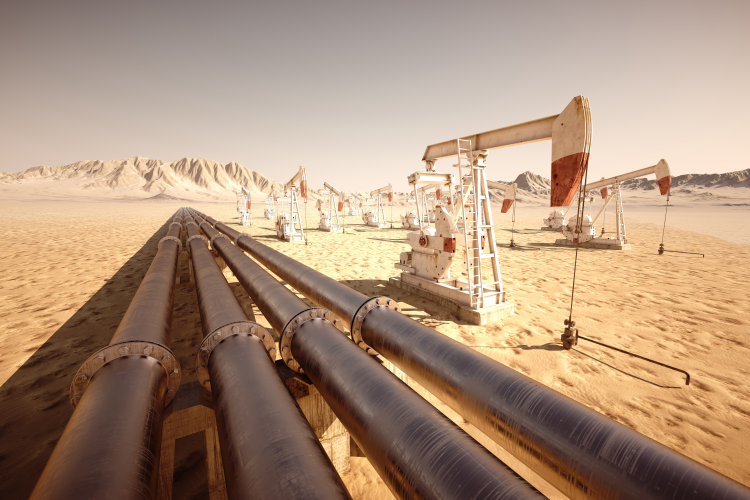
In 2026, if I am right, the following five trends will heavily influence the direction of the global oil and natural gas industry. Overall, the forecast is for weak prices, and rising production as demand continues to grow amid reduced political risk.
1. AI data centre construction will accelerate
In 2025, tech giants and others announced billions of dollars in artificial intelligence data centre investments to build multiple facilities in the coming years. Here is one forecast:
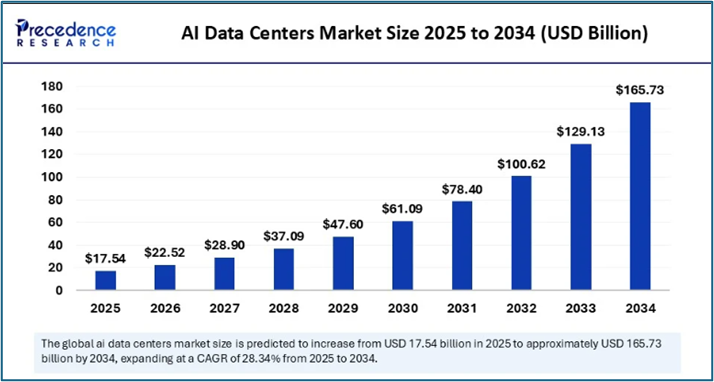
Source: AI Data Centers Market Size and Forecast 2025 to 2034, Precedence Research
In 2026, many of these proposals will accelerate toward construction and operation, leading to increased natural gas consumption. Jurisdictions that offer the following will have an advantage in attracting data centres:
-
- Cheap natural gas for electricity generation.
- Inexpensive land and sufficient infrastructure, such as roads, airports and telecommunications.
- Pro-business attitude to smooth the permitting process.
- Openness to private investment in electricity generation and transmission.
- Easy access to water and cool temperatures to help reduce air-conditioning requirements.
Access to electricity from the existing distribution grid is not an advantage, as AI data centres require much more electricity than is available in surpluses. Also, existing customers will protest against any hint that their price will increase due to data-centre load.
Where AI data centre investments in the U.S. will most likely occur is described in this article: Selected U.S. States Offer Enormous Advantages for AI Data Centers, EnergyNow Media.
2. Crude oil price decreases will continue
In 2025, global crude oil prices declined, as illustrated in the chart below.
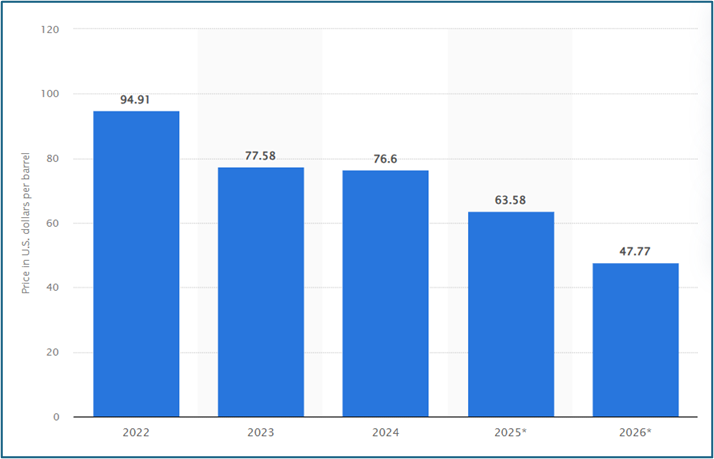
Source: West Texas Intermediate (WTI) from 2022 to 2026, Statista
In 2026, the global crude oil market will continue to be oversupplied because of the following:
-
- OPEC+ is increasing crude oil production in an attempt to gain market share.
- Increasing crude oil production in Canada, Brazil, Guyana, Kazakhstan, and the U.S., among others.
- Weak outlook for global economic growth, especially in China, as demand growth slows amid uncertainties surrounding U.S. tariffs.
- Sanctions imposed on Iran and Russia are reducing the prices these countries receive, but not their sales volumes.
Even the following military events, which interfere with crude oil exports, are unlikely to keep crude oil prices from weakening:
-
- The extradition of Nicolás Maduro, the president of Venezuela, is most likely to lead to a modest increase, not a decrease, in Venezuelan crude oil exports.
- Ukraine is bombing empty Russian tankers in the Black Sea.
- Ukraine is bombing Russian energy infrastructure, including Russian oil terminals in the Black Sea, which also affects Kazakhstan’s exports.
- The possibility that the U.S. Navy will continue blockading crude oil shipments from Venezuela if its political leaders fail to co-operate with the U.S.
Oil and natural gas producers are bracing for strong headwinds in 2026. Chevron, Exxon Mobil, and TotalEnergies have all lowered their capital spending plans by around 10% and announced deep cuts in operating and administrative costs. These cutbacks may influence crude oil prices in future years.
3. Flat natural gas prices will continue
In 2025, global natural gas prices continued their steady trend, as illustrated in the chart below.
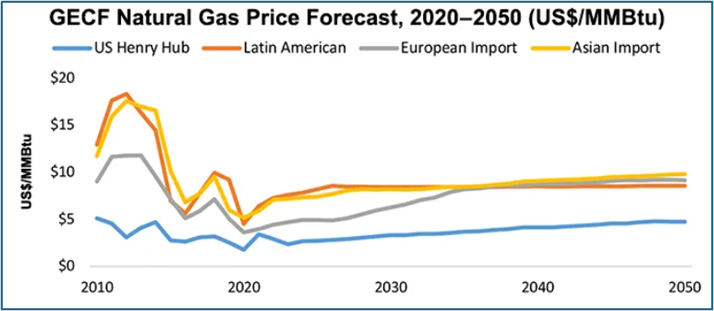
Source: Natural Gas to Become World’s Primary Fossil Fuel by 2050, Natural Gas Intelligence
In 2026, the global natural gas market will remain flat due to abundant production that will more than meet significantly increasing demand caused by:
-
- Shifting the energy source for electricity generation from coal and oil to natural gas.
- Significant additions to LNG export capacity, primarily in the U.S. and Qatar, consuming a substantial portion of this record production.
- Rapidly growing natural-gas-fired electricity consumption in AI data centres.
Even the following potentially disruptive events will not increase prices much:
-
- The near elimination of European purchases of Russian natural gas and LNG. The U.S. and Qatar will benefit from additional LNG sales.
- Sanctions imposed on Iran and Russia are reducing the prices these countries receive, but not their sales volumes.
- Russian natural gas and Arctic LNG volumes selling to China will continue to increase because China is not honouring the sanctions.
- Lifting sanctions on Russia, if the Russian invasion of Ukraine stops, will not restart European countries’ purchases of natural gas and LNG.
4. Energy transition goals will become more modest
In 2025, European nations and Canada started to revise and extend their ambitious energy transition goals and related implementation dates, due to the following developments:
-
- The high cost of renewable electricity generation.
- Unaffordable subsidies for low-carbon energy production and consumption.
- Unsustainable budget deficits.
- The threat of deindustrialization due to high energy prices.
- A reluctance to build more nuclear-powered electricity generation.
- The need to shift government spending to defence.
- Lower crude oil prices are lowering gasoline prices. That trend will reduce interest in buying electric and hybrid vehicles.
Together, these developments undermine efforts to achieve a rapid energy transition. As a result, global demand for crude oil and natural gas will persist longer and decrease slowly, as shown in the chart below.
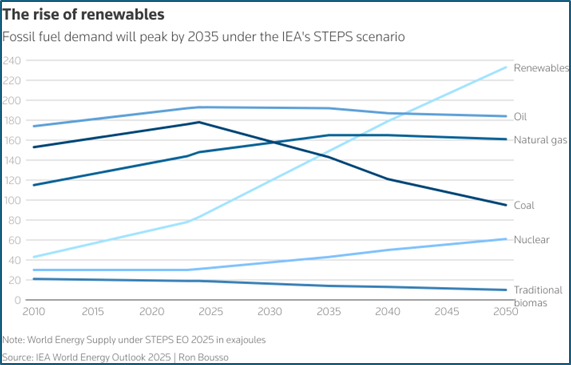
Source: Energy market trends to track in 2026, the year of the glut, Reuters
Even as energy transition goals become more modest, significant growth in renewable electricity generation will continue in 2026 and beyond. The International Energy Agency (IEA) forecast of peak fossil fuel consumption by 2035 seems unlikely – https://big-media.ca/technology-is-the-path-to-near-limitless-hydrocarbons/.
The following article further describes the likely patterns of energy consumption by fuel type: Global Energy Consumption Forecasting in the Age of Climate Change, EnergyNow Media.
5. Energy industry will implement AI applications
In 2025, rapid AI advances captured the attention of many organizations. AI headlines promised vast increases in productivity and new applications previously impossible. However, in the oil and natural gas industry, the impact of AI is more practical – streamlining operations rather than inventing new exploration and production technologies, or conquering new markets.
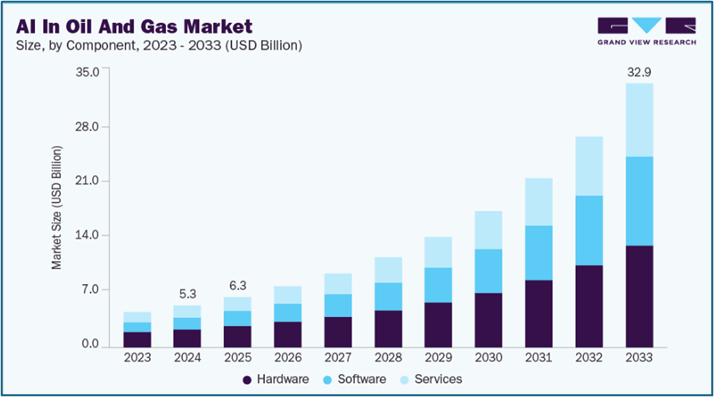
Source: AI In Oil And Gas Market (2025 – 2033), Grand View Research, Inc.
In 2026, we can expect more AI adoption as AI software becomes more robust and companies become more confident in the technology. For additional details, read How Will AI Impact the Oil and Natural Gas Industry?
Overall, these five predictions suggest a modest increase in activity in the global oil and natural gas industry in 2026.
(Yogi Schulz, BIG Media Ltd., 2026)