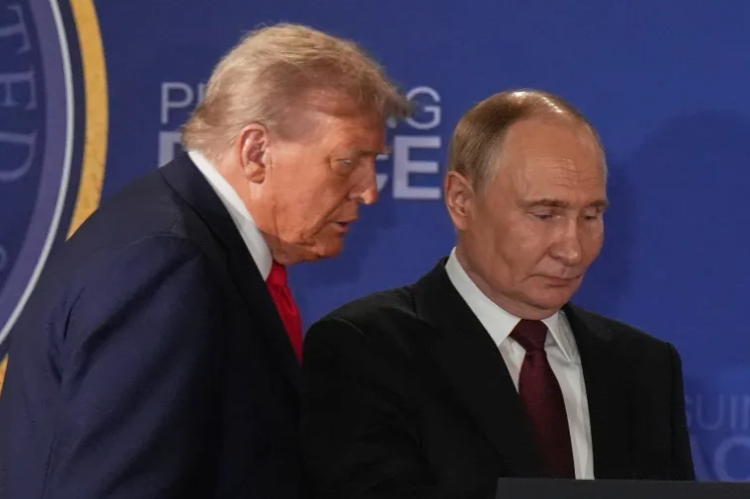
(Al Jazeera Media Network) The New START treaty, the last of the nuclear arms control treaties between the United States and Russia, which was signed in 2010, will expire on Thursday.
Here is what the treaty entails, and what its lapse could mean for Washington and Moscow:
START stands for Strategic Arms Reduction Treaty. It was a 10-year agreement signed in 2010 by then-US President Barack Obama and Dmitry Medvedev, a close ally of Vladimir Putin who served a single term as Russia’s president from 2008 to 2012. It came into effect in 2011.New START was an extension of earlier treaties. START I, which reduced the number of strategic warheads in deployment in both the US and Russia, was signed between the US and the Soviet Union at the end of the Cold War in 1991 and was in place until 2009. START II, which aimed to further reduce the number of deployed strategic nuclear warheads and remove multiwarhead intercontinental ballistic missiles altogether, was signed in 1993 but never entered into force. Russia formally withdrew from it in 2002.
From 2003 to 2011, the Strategic Offensive Reductions Treaty (SORT) was also in place. It required both sides to reduce operationally deployed strategic warheads, but it included minimal checks, relying on START I’s mechanisms for monitoring. This is what was replaced by New START in 2011.
New START was extended in 2021 for five more years after US President Joe Biden took office. The treaty states that it can only be extended once.
The treaty limits the deployment of strategic nuclear weapons, those designed to hit an adversary’s key political, military and industrial centres.
Deployed weapons or warheads are those in active service and available for rapid use as opposed to those that are in storage or awaiting dismantlement.
Under the agreement, Moscow and Washington are committed to the following:
- Deploying no more than 1,550 strategic nuclear warheads and a maximum of 700 long-range missiles and bombers.
- Limiting intercontinental ballistic missiles in deployment to 800.
- Allowing up to 18 inspections of strategic nuclear weapons sites yearly by the other side to ensure the other has not breached the treaty’s limits.
The treaty allowed each country to send inspectors to the other country’s nuclear sites with little advance warning.
These inspections were put on hold in March 2020 because of the COVID-19 pandemic. Inspections have not resumed.
In 2022, Russia launched its full-scale invasion of Ukraine and a war that continues.
In 2023, Russian President Putin suspended Moscow’s participation in the New START treaty, citing Washington’s support for Ukraine during the war.
This meant that Russia stopped participating in inspections and sharing data but was still party to the treaty.
That put an end to on-site inspections and left both countries dependent on their own intelligence to judge the other’s compliance. Despite this, neither side has alleged that the other has violated the warhead limits, which are still in effect.
The US and Russia are the two biggest nuclear powers in the world in terms of the number of warheads they possess. Together, the US and Russia possess about 90 percent of all nuclear warheads in the world.
The Center for Arms Control and Non-Proliferation (CACNP) estimated that Moscow currently has 5,459 nuclear warheads, of which 1,600 are actively deployed.
The US has about 5,550 nuclear warheads, according to the CACNP, with about 3,800 of those active. At its peak in the mid-1960s during the Cold War, the US stockpile consisted of more than 31,000 active and inactive nuclear warheads.
US President Donald Trump appears eager to reach a new agreement to restrict nuclear weapons.
During an interview with The New York Times in January, Trump said of the New START treaty: “If it expires, it expires. … We’ll just do a better agreement.”
Trump has also said he would like to include China in any nuclear talks. “We are talking about limiting nuclear weapons. We will get China into that,” Trump said in August.
Separately that same month before a meeting with South Korean President Lee Jae Myung, Trump said: “I think the denuclearisation is a very – it’s a big aim, but Russia is willing to do it, and I think China is going to be willing to do it, too. We can’t let nuclear weapons proliferate. We have to stop nuclear weapons. The power is too great.”
Medvedev, who is currently the deputy chairman of Russia’s Security Council, warned that if the New START treaty expires, it will mean the biggest nuclear powers will have unlimited capacity to expand their nuclear programs for the first time since the 1970s.
“I don’t want to say that this immediately means a catastrophe and a nuclear war will begin, but it should still alarm everyone,” Medvedev said in an interview at his residence outside Moscow on Monday, which was reported by the Reuters and TASS news agencies and the WarGonzo Russian war blogger.
In September, Putin suggested that both countries should just keep abiding by the warhead limits, without a formal deal, for one more year.
“To avoid provoking a further strategic arms race and to ensure an acceptable level of predictability and restraint, we believe it is justified to try to maintain the status quo established by the New START treaty during the current, rather turbulent period,” Putin said in televised remarks at the Kremlin.
The Trump administration has not officially responded to this proposal.
At times, Putin has appeared more relaxed about the treaty, however. In October, he told reporters that Russia was developing new strategic weapons and it would not be critical for Moscow if the US declined to extend the warhead limits set out in New START.
At the time, he told reporters: “Will these few months be enough to make a decision on an extension? I think it will be enough if there is goodwill to extend these agreements. And if the Americans decide they don’t need it, that’s not a big deal for us.”
When the treaty lapses, the legal limits on the number of deployed strategic nuclear warheads the US and Russia can each have will disappear.