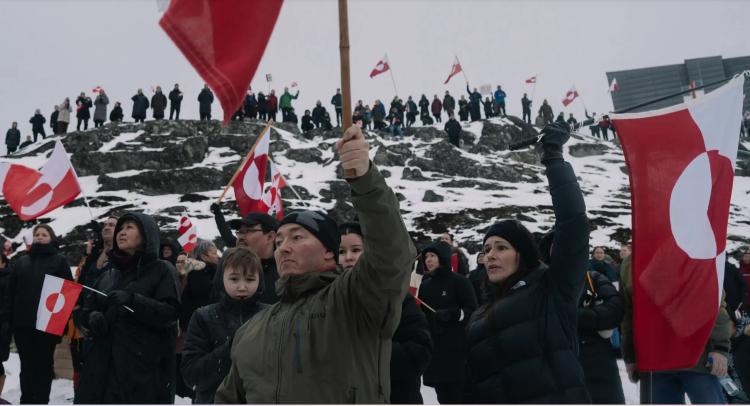
(New York Times) In a single post on Saturday night, United States President Trump upended months of progress on trade negotiations with an ultimatum that puts Europe on a crash course with the United States — long its close ally and suddenly one of its biggest threats.
In the Truth Social post, Trump demanded a deal to buy Greenland, saying that otherwise he would slap tariffs on a group of European nations, first 10 percent in February, then 25 percent in June.
It appeared to leave little room for Europe to maneuver or negotiate in a harsh and combative era of geopolitics. It also left Europe with few options to counter Trump without repercussions.
European leaders are loath to accept the forced takeover of an autonomous territory that is controlled by Denmark, a member of both NATO and the European Union.
Officials and outside analysts increasingly argue that Europe will need to respond to Trump with force — namely by hitting back on trade. But doing so could come at a heavy cost to both the bloc’s economy and its security, since Europe remains heavily reliant on the United States for support through NATO and in Russia’s war with Ukraine.
“We either fight a trade war, or we’re in a real war,” said Jacob Funk Kirkegaard, a senior fellow at Bruegel, a research institute in Brussels.
Europeans have spent more than a year insisting that Greenland is not for sale and have constantly repeated that the fate of the massive northern island must be decided by its people and by Denmark. Last week, a group of European nations sent personnel to Greenland for military exercises — a show of solidarity that may have triggered Trump, since the same nations are the ones to be slapped with tariffs.
The exercises were intended to reinforce Europe’s commitment to policing the Arctic. Trump has insisted that the United States needs to own Greenland to improve security in the region.
In that sense, the exercises were part of an ongoing effort to placate Trump. For weeks, officials across Europe had dismissed Trump’s threats to take Greenland, even by military force, as unlikely. Many saw them more as negotiating tactics and hoped that they could satisfy the American president with a willingness to beef up defense and spending on Greenland.
But Trump’s fixation on owning the island and his escalating rhetoric is crushing European hopes that appeasement and dialogue will work. Scott Bessent, the American Treasury secretary, doubled down on that message in a Sunday morning interview on NBC’s “Meet the Press.”
American ownership of Greenland would be “best for Greenland, best for Europe and best for the United States,” Bessent said, suggesting that would be the case even if Greenland were taken by military force.
“The European leaders will come around,” he added.
There is little sign of that. Facing the reality that a negotiated compromise is less and less likely, Europeans are now racing to figure out how to respond to Trump’s pressure campaign.
Within hours of the post, members of the European Parliament announced that they would freeze the ratification of the trade deal that Trump and Ursula von der Leyen, the president of the European Commission, struck last summer. And members of European Parliament are openly calling for trade retaliation. Ambassadors from across the 27-nation bloc gathered in Brussels on Sunday for an emergency meeting, diplomats said.
Europe has a trade weapon specifically created to defend against political coercion quickly and forcefully, and as Trump’s threats sank in, policymakers argued that this is the time to wield it.
The tool — officially called the “anti-coercion instrument,” unofficially called Europe’s trade “bazooka” — could be used to slap limitations on big American technology companies or other service providers that do large amounts of business on the continent. But using it would sharply ratchet up trans-Atlantic tensions.
Europe has spent the past year avoiding such escalation, and for a reason. The continent remains deeply reliant on the United States for NATO protection and for support against Russia in the war on Ukraine, so a full-on trade war could have consequences on other fronts.
“The question is — how far do you want to go?” said Penny Naas, an expert on European public policy at the German Marshall Fund think tank.
https://www.nytimes.com/2026/01/18/world/europe/greenland-us-trade-war.html