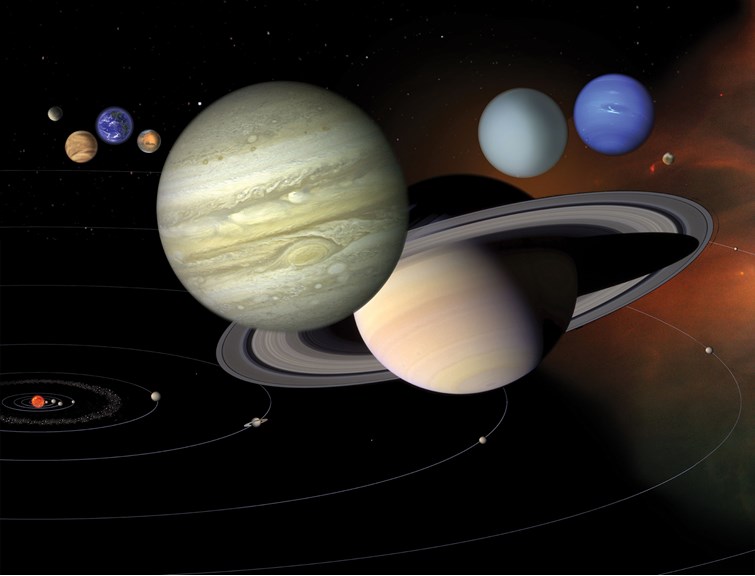
(BBC News) There will be a chance to see all the planets in the solar system in the night sky today (Thursday).
Five should be visible with the naked eye, while the two farthest away, Uranus and Neptune, will be better viewed with binoculars.
The best time to see the spectacle is shortly after sunset.
Those farther south, including southern Europe or closer to the equator, are more likely to be able to see all the planets appear in a vertical line up into the sky.
Mercury will be more visible farther south. Unlike stars, planets do not twinkle. Saturn and Jupiter will be brightest, and Mars will be a salmon red.
Anyone looking through a telescope should be able to see details such as the moons of Jupiter and perhaps cloud systems or dark markings on Jupiter and Mars, says Dr Robert Massey of the Royal Astronomical Society.