(Al Jazeera Media Network) China’s trade surplus – the difference between the value of goods it imports and exports – has hit $1 trillion for the first time, a significant yardstick in the country’s role as “factory of the world”, making everything from socks and curtains to electric cars.
For the first 11 months of this year, China’s exports rose to $3.4 trillion while its imports declined slightly to $2.3 trillion. That brought the country’s trade surplus to about $1 trillion, China’s General Administration of Customs said on Monday.
Shipments overseas from China have boomed despite US President Donald Trump’s global trade war, largely consisting of sweeping “reciprocal” tariffs on most countries, which were launched earlier this year in a bid to reduce US trade deficits.
But China, which was initially hit with US tariffs of 145 percent before they were lowered to allow for trade talks, has emerged largely unscathed from the standoff by stepping up shipments to markets outside the US.
Following Trump’s 2024 election win, China began diversifying its export market away from the US in exchange for closer ties with Southeast Asia and the European Union. It also established new production hubs, outside of China, for low-tariff access.
China’s exports returned to growth last month following an unexpected dip in October, rising to 5.9 percent more than one year earlier and far outpacing a 1.9 percent rise in imports, according to China’s General Administration of Customs.
China’s goods surplus for the first 11 months of 2025 was up 21.7 percent from the same period last year. Most of the surge was driven by strong growth in high-tech goods, which outpaced the increase in overall exports by 5.4 percent.
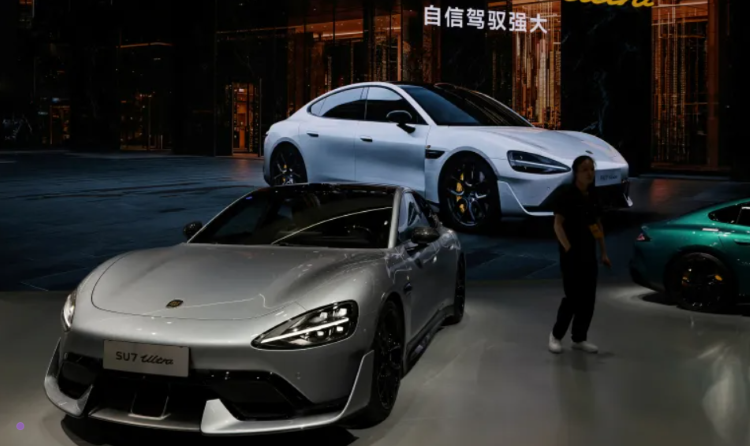
Auto exports, especially for electric vehicles, rallied as Chinese firms muscled in on Japanese and German market share. Total car shipments jumped by more than one million to approximately 6.5 million units this year, according to data from China-based consultancy Automobility.
And although China still trails US leaders like Nvidia in advanced chips, it is becoming dominant in the production of semiconductors (used in everything from electric cars to medical devices). Semiconductor exports rose by 24.7 percent over the period.
China’s technological advances have also boosted shipbuilding, where exports rose 26.8 percent compared with the same period in 2024.
So, given the hostile global trade backdrop, how has China achieved this?
Though Washington has lowered tariffs on Chinese imports in recent months, they remain high. Average import duties on Chinese goods currently stand at 37 percent. For this reason, Chinese shipments to the US have dropped by 29 percent year-on-year to November.
Some Chinese companies have shifted their production facilities to Southeast Asia, Mexico and Africa, enabling them to bypass Trump’s tariffs on goods arriving directly from China. Despite this, overall trade between the two countries remains down.In the first eight months of this year, for instance, the US imported roughly $23 billion in goods from Indonesia, an increase of nearly one-third on the same period in 2024. It is widely understood that the rise is down to Chinese goods being redirected via Indonesia.
“The role of trade rerouting in offsetting the drag from US tariffs still appears to be increasing,” Zichun Huang, an economist at Capital Economics, wrote in a note to clients on Monday. Huang added that “exports to Vietnam, the top [Chinese] rerouting hub, continued to grow rapidly.”
As trade with the US has slackened, China has doubled down on developing ties with other major trading partners. That includes a 15 percent surge in Chinese shipments to the EU, compared with the year before, and an 8.2 percent rise in exports to countries in Southeast Asia.
Another reason for China’s trading success is that its currency has been cheap, compared with others, in recent years. A lower renminbi makes exports relatively inexpensive to produce, and imports relatively expensive to consume.
China maintains a “managed float” of the renminbi – meaning the central bank intervenes in foreign exchange markets to maintain its value against other currencies – with the aim of keeping the price stable.
For years, many economists have argued that China’s currency is undervalued. In their view, that gives exporters a competitive edge by boosting the appeal of cheap Chinese products at the expense of other countries, leading to large imbalances in trade.
Indeed, taking into account global inflationary dynamics, the real effective exchange rate – a measure of the competitiveness of Chinese goods – is actually at its weakest level since 2012.
China’s $1-trillion trade surplus – never before recorded in economic history – is the culmination of decades of industrial policies that have enabled China to emerge from a low-income agrarian society in the 1970s to become the world’s second-largest economy today.
https://www.aljazeera.com/news/2025/12/9/how-did-chinas-trade-surplus-hit-1-trillion