(Al Jazeera Media Network) The United States and Israel on Saturday launched an attack on Iran, with explosions seen across Tehran and in multiple cities across the country. Tehran has responded by launching waves of missiles and drones at Israel and towards several military bases in the Middle East where US forces operate.
Iran had previously warned that if it were attacked, it would respond by targeting US military facilities across the region. “This operation will continue relentlessly until the enemy is decisively defeated,” Iran’s Islamic Revolutionary Guard Corps (IRGC) said. All US assets throughout the region are considered legitimate targets for Iran’s army, it added.
Details of casualties and damage are still being collected.
US and Israeli attacks on Iran
At about 9:27am (06:27 GMT), Iran’s semi-official Fars news agency reported a series of explosions in the capital, Tehran.
Al Jazeera’s correspondent in western Tehran said he heard two explosions, while videos shared on social media showed smoke rising from several parts of the city.
Tehran
Missiles struck several areas of Tehran, including districts where key government ministries and military compounds are located.
Iranian media reported strikes on the Ministry of Intelligence, the Ministry of Defence, the Atomic Energy Organization of Iran and the Parchin military complex.
Several missiles also hit University Street and the Jomhouri area of the capital, according to the Fars News Agency. Mehr News Agency reported that at least two students were killed in an attack on a school east of the capital.
Iran’s National Security Council has advised residents to leave Tehran amid fears of further escalation.
Minab
In the southern city of Minab, an Israeli strike hit an elementary girls’ school, killing at least 51 people, state media reported.
Isfahan
While it is not yet clear what was hit, the central city of Isfahan was previously targeted in strikes in 2025 by the US and Israel, when military and nuclear-linked facilities in the area were attacked.
Isfahan is considered a key hub for Iran’s ballistic missile programme, with production plants and research facilities in and around the city.
Other locations that were struck include: Kermanshah, Qom, Tabriz, Ilam, Karaj, Lorestan province, Zanjan, Urmia, Bushehr, Damavand, and Shiraz.
These locations are shown in the map below. Al Jazeera will update it as more information becomes available.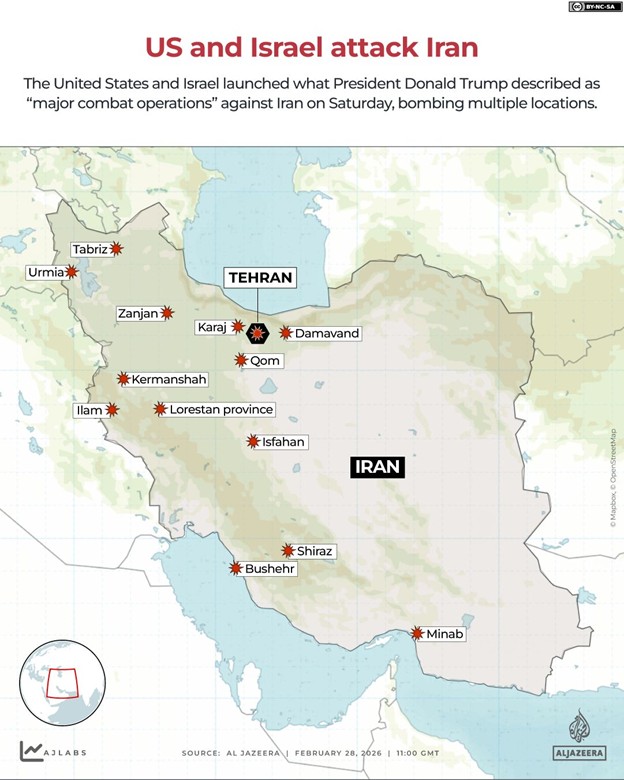 Iranian attacks on Israel and US targets in the Gulf
At their closest points, Israel and Iran are less than 1,000 km apart. The distance from Tel-Aviv to Iran’s capital, Tehran, is about 1,600 km.
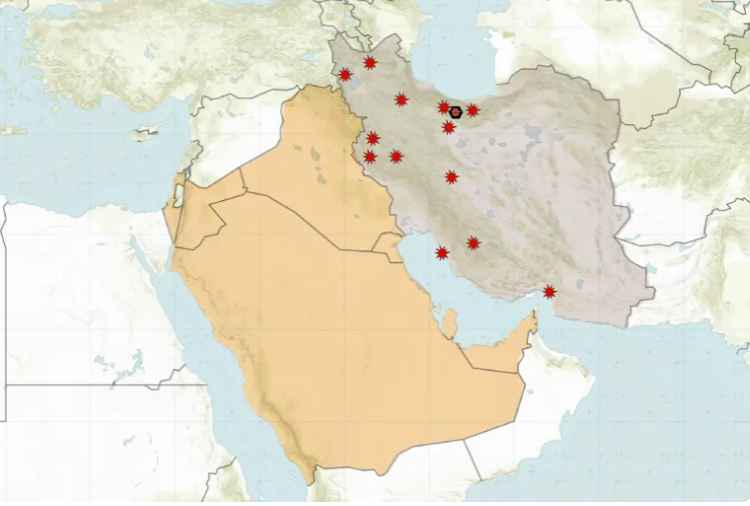
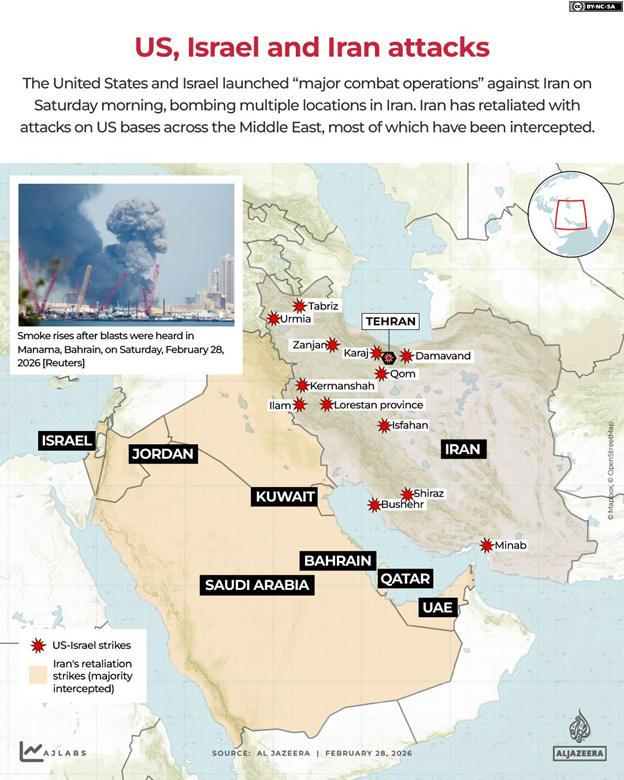
Iran has retaliated by attacking US bases across the Middle East. Most of these attacks have been intercepted.
 Israel
Israel has declared a “special state of emergency”. Multiple explosions were reported in the skies above northern and central parts of Israel, including in the Tel Aviv area and Haifa, where sirens have been sounding continuously.
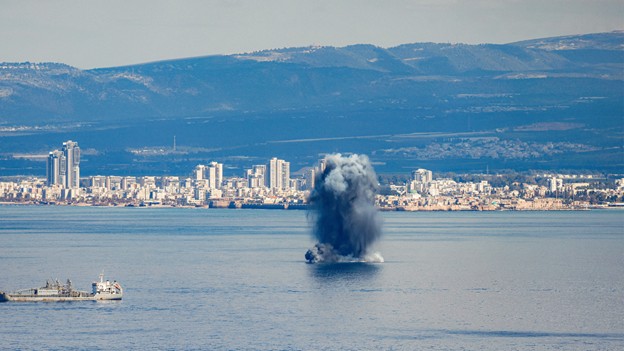 Israeli defence system intercepts Iranian missiles over Haifa
The Israeli army said it was intercepting a new wave of Iranian missiles, prompting people to shelter in bunkers.
A nine-storey building was hit in northern Israel after Iranian missiles had been intercepted, leaving one man with minor injuries after he was struck by shrapnel from interceptor missiles, according to Israel’s Channel 12 broadcaster.
Qatar
Smoke was seen billowing from a residential area on the outskirts of the capital, caused by falling debris from an intercepted missile.
Several interceptions were made: The Ministry of Defense says it “thwarted” several attacks on the country.
UAE
A Pakistani national was killed in the UAE after being struck by falling debris, according to the Ministry of Defence. The ministry says it has intercepted a wave of missiles.
There were also reports of explosions heard in Dubai, which might have been caused by the interceptions.
Bahrain
Bahrain says a missile attack targeted the headquarters of the US Navy’s 5th Fleet, which it hosts.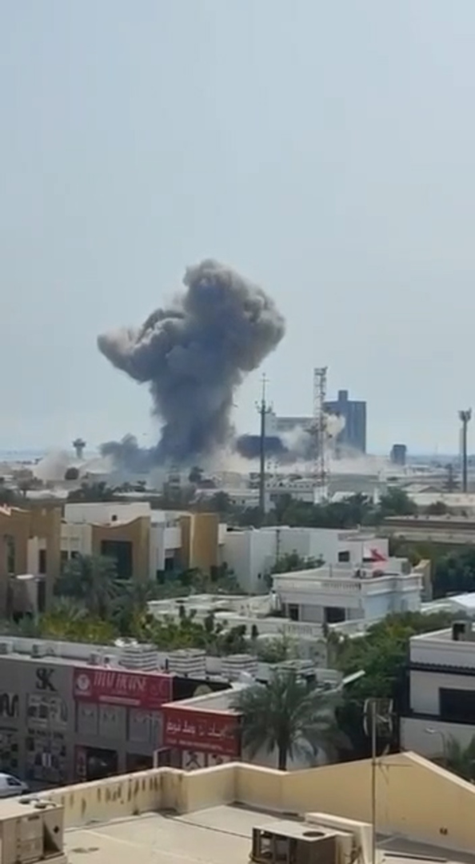 Kuwait
Kuwait’s Ministry of Defence says that Ali al-Salem Air Base came under attack by a number of ballistic missiles, all of which were intercepted by Kuwaiti air defence systems.
Saudi Arabia
Loud explosions were heard in the Saudi capital, Riyadh, the AFP news agency reported. Saudi Arabia’s Ministry of Foreign Affairs issued a statement standing in solidarity with Qatar, Jordan, Bahrain, Kuwait and the UAE.
Iraq
A drone attack reportedly attempted to target Erbil International Airport, but air defences intercepted it.
Jordan
Missiles have been intercepted over Amman, and flaming debris fell near a house. There were no reported injuries.
US military presence in the Middle East
The US has operated military bases in the Middle East for decades.
According to the Council on Foreign Relations, the US operates a broad network of military sites, both permanent and temporary, across at least 19 locations in the region.
Of these, eight are permanent bases, located across Bahrain, Egypt, Iraq, Jordan, Kuwait, Qatar, Saudi Arabia and the UAE.
As of mid-2025, there are about 40,000 to 50,000 US soldiers in the Middle East, consisting of personnel stationed in large, permanent bases and smaller forward sites across the region.
The countries with the most US troops include Qatar, Bahrain, Kuwait, the UAE and Saudi Arabia. These installations serve as critical hubs for air and naval operations, regional logistics, intelligence gathering and force projection.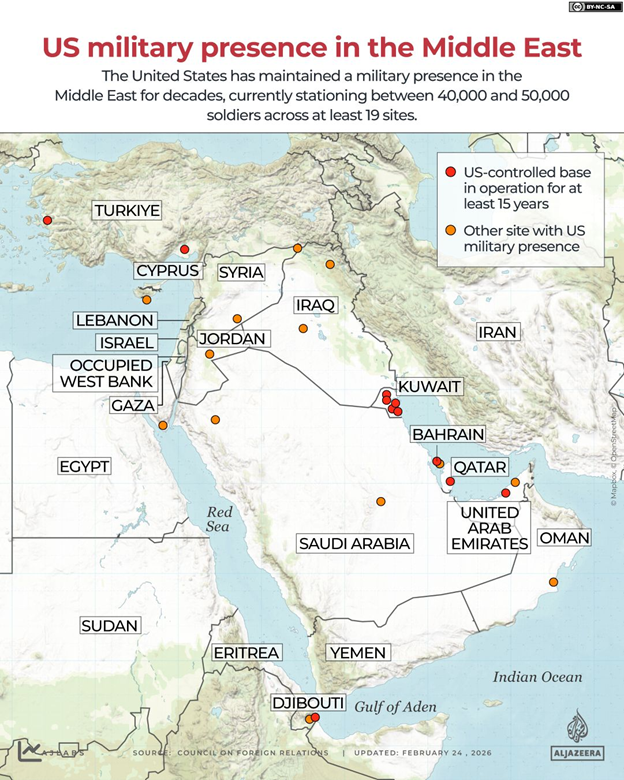 Major US military buildup in the region
The US has amassed its largest military presence in the Middle East in decades.
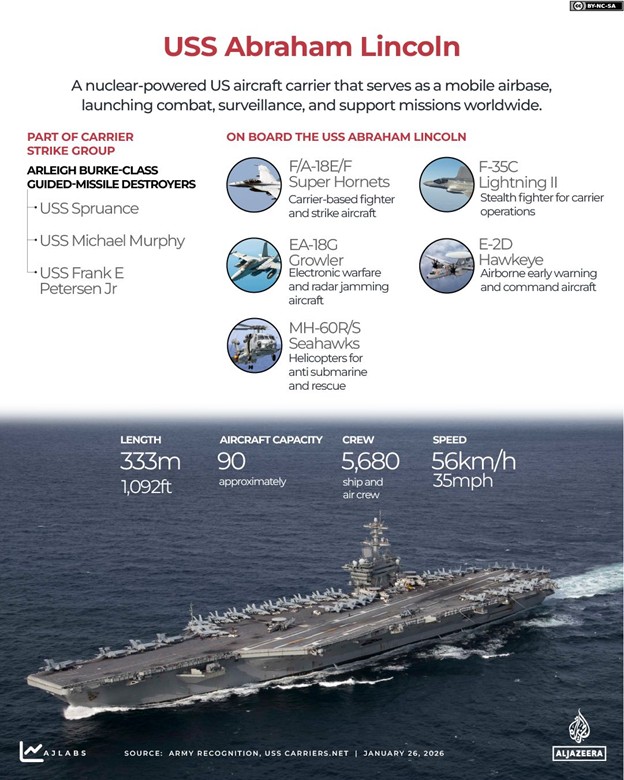
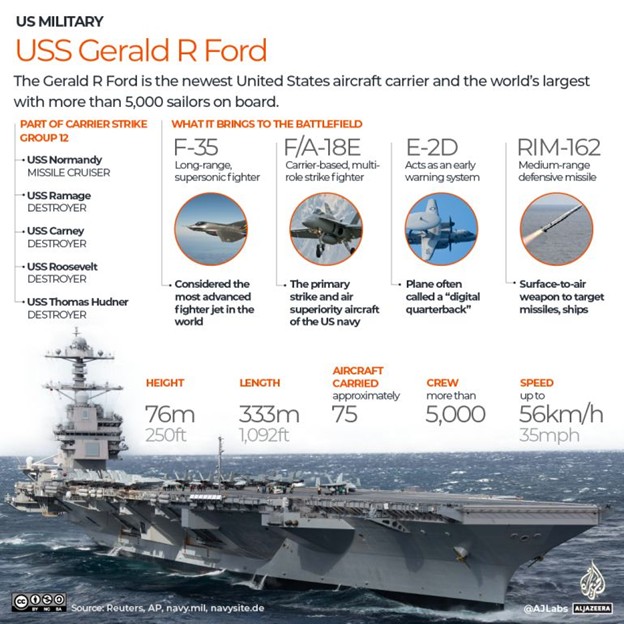
This historic buildup features two carrier strike groups: the USS Abraham Lincoln in the Arabian Sea and the USS Gerald R Ford off Israel’s coast, supported by more than 150 aircraft and dozens of warships.
The USS Abraham Lincoln is a 333-metre-long, nuclear-powered aircraft carrier that can carry approximately 80 to 90 aircraft, including F-35C Lightning II stealth fighters, F/A-18E/F Super Hornets, and E-2D Advanced Hawkeye early-warning planes.
 The USS Gerald R Ford, the world’s largest aircraft carrier, was the same vessel that previously supported US military operations in Venezuela, including missions conducted under Operation Southern Spear.
 Iran’s missile arsenal
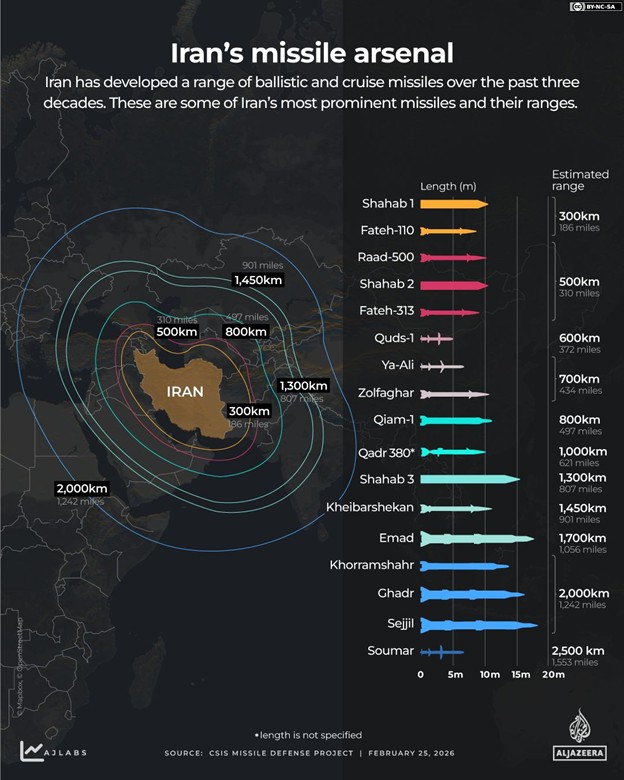
The size of Iran’s ballistic missile arsenal is unclear, but it is widely considered one of the largest and most advanced in the region.
Iran has developed a range of ballistic and cruise missiles over the past three decades. The graphic below summarizes some of Iran’s most prominent missiles and their ranges.
 How ballistic missiles work and where they can reach
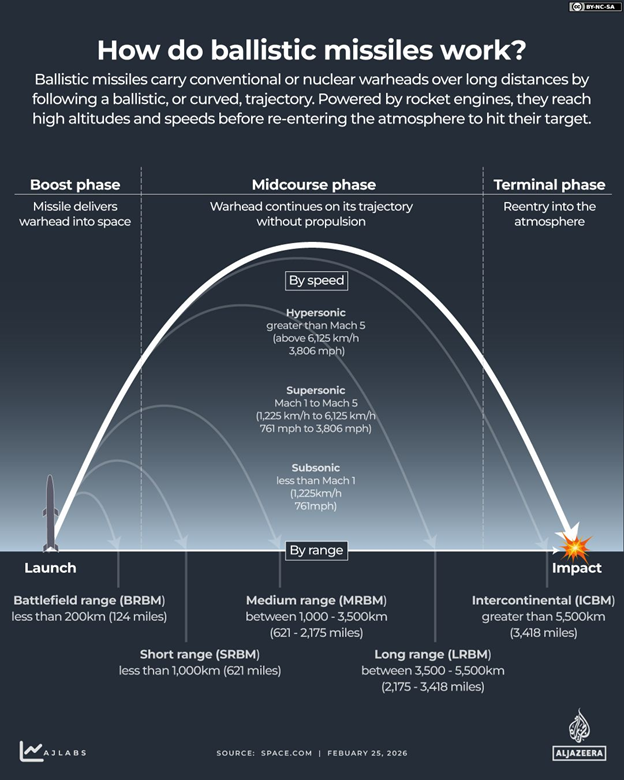
Ballistic missiles are long-range weapons designed to deliver conventional or nuclear warheads by following a ballistic, or curved, trajectory.
Launched using powerful rocket engines, these missiles shoot upwards into the upper atmosphere or even space, travelling at incredibly high speeds. Once their engines are cut off, the missile follows a predetermined path, re-entering the Earth’s atmosphere in a steep descent before striking its target.
Ballistic missiles travel at extremely high speeds, allowing them to travel thousands of kilometres in just minutes.
The speed at which they travel is measured in Mach, a unit equivalent to the speed of sound; for example, Mach 5 means five times the speed of sound.
Some, usually shorter-range, ballistic missiles reach supersonic speeds (faster than Mach 1, or about 1,225 kilometres per hour), while others, usually longer-range missiles, can travel at hypersonic speeds – greater than Mach 5 (6,125 km/h).
What makes ballistic missiles especially dangerous is their combination of long range, high speed, and how difficult they are to intercept.
Their fast, high-flight path gives defence systems little time to react, and when they re-enter the atmosphere, they descend even faster, making interception even more difficult. Some missiles also deploy decoys or other countermeasures to trick radar and missile defences, making them harder to intercept.
Israel’s missile arsenal
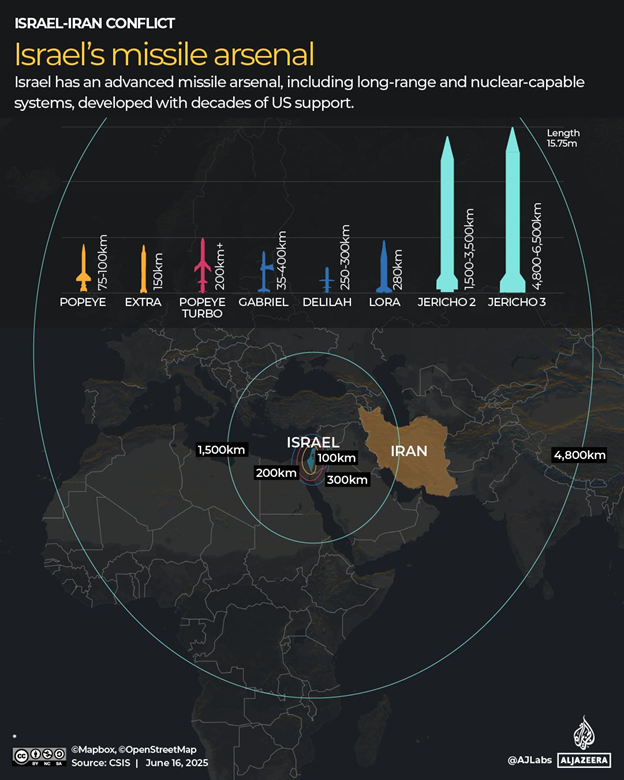
Israel has an advanced missile arsenal, including long-range and nuclear-capable systems, developed with decades of support from the US. The graphic below highlights some of Israel’s most notable missiles along with their respective ranges.
 What are Israel’s air defence capabilities?
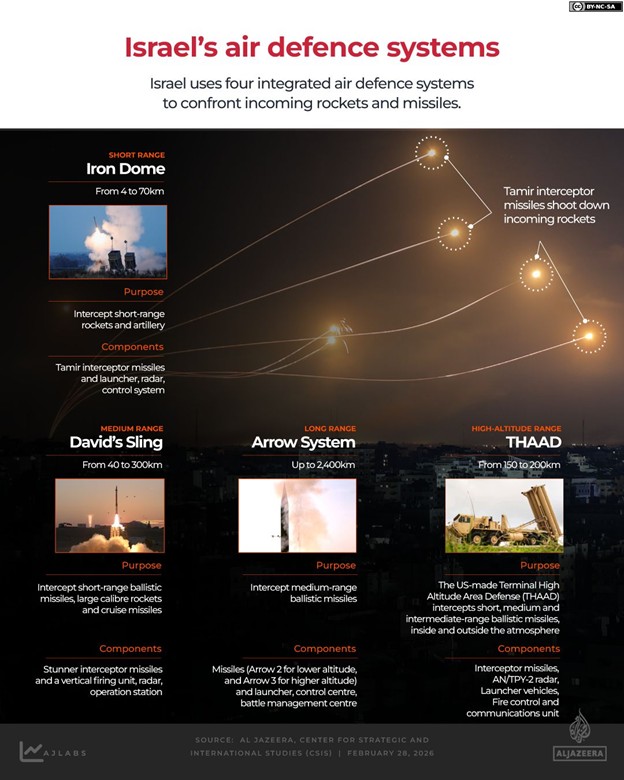
The Israeli air defence relies largely on what is known as the Iron Dome system, which is equipped with a radar that detects an incoming projectile, as well as its speed and direction.
Other systems intercept medium- and long-range missiles. The David’s Sling intercepts missiles ranging between 40 km and 300 km. The Arrow System intercepts missiles with a range of up to 2,400 km.
In addition, the US has two Terminal High Altitude Area Defense (THAAD) batteries deployed in Israel to bolster the country’s defences. The THAAD system is designed to intercept short-, medium- and intermediate-range ballistic missiles.