Securing the internet and combatting misinformation and disinformation have been high priorities for governments across the western world since the COVID-19 pandemic began about six years ago. Citizens in many countries have had to contend with a range of policies intended to control speech, online content, and independent media.
At the start of this decade, social media platforms including Facebook, Instagram, Twitter, and Linkedin were front and centre in the censorship game through their so-called ”fact checkers” and moderators.
Youtube and Google imported notes under videos and searches showing recommended guidelines and reports from their “trusted experts”.
Dissent from the pro-lockdown/vaccinate narrative was met with deletion of posts, shadow-banning, demonetizing of accounts and channels, and temporary or permanent banishment of repeat offenders.
Content creators and journalists were suddenly forced to play along with an ever-changing set of vaguely defined rules for conduct on the platforms they used in earning a living. Ensuing self-censorship, combined with blatant censorship by large media companies, stifled constructive conversation about the COVID pandemic, the war in Ukraine, climate change, and other important matters.
The public in large part was kept out of the loop and denied access to critical information.
In July of 2025, the UK’s Online Safety Act met one of its milestones, making age verification a requirement to use the internet. Its implementation means UK citizens are now required to show a photo ID to access online content. In turn, online service providers are required to keep their users’ data safe. This puts both the user and the source of content in jeopardy as the legal challenge of keeping data safe unfolds.[1]
The UK public’s reaction to this new law has been humorous at times, with some using video games to create characters that function as an ID to access the internet.[2] Another tool that the public has turned to is the use of virtual private networks (VPNs), as providers of internet protocol (IP) masking tools saw a surge in new users on July 25. Proton VPN has reported a 1,800% uptick,[3]and Nord VPN has reported a 1,000 % increase from UK customers.[4]
Brits also flocked to support a petition for the repeal of the Online Safety Act, obtaining more than 550,000 signatures, enough to prompt debate in Parliament.[5]However, the UK government, led by its Labour Party majority, rejected the motion to repeal last month, saying it will instead focus on proper implementation of the act.
Some politicians have spoken out against the Online Safety Act, as Nigel Farage, leader of Reform UK, has pledged to repeal it because it suppresses free speech in Britain.
“… until the online safety act came into being this weekend, which begins to look (like) state suppression of genuine free speech may be upon us already,” Farage said.[6]
Effects of the Online Safety Act include small online media platforms and community forums shutting down. Some of those sites and communities had been active since the 1990s, some with 100,000+ accounts and thousands of daily users.[7]
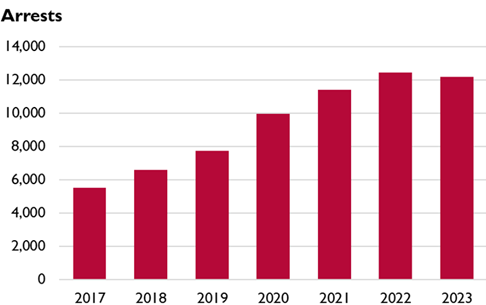
The Online Safety Act and its age-verification mandate came amid widespread arrests for posts, memes, likes, and shares on social media. Numbers from the Lord’s Library show that in 2017 just under 6,000 people were arrested for ”malicious communications”. That number rose to over 12,000 in each of 2022 and 2023.[8]
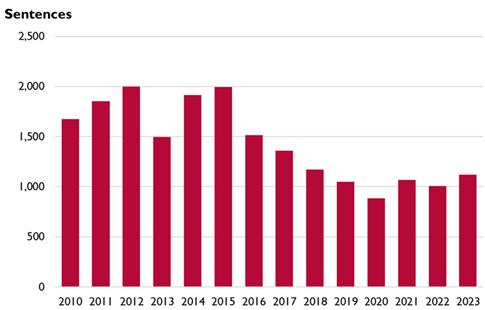
While arrests were mostly on the rise, the number of Brits receiving a sentence for malicious communication online had been falling through 2020 before increasing slightly from 2021-23.
In 2023, 12,183 arrests were registered, an average of 33 a day. While citizens are receiving sentences for posts that call for violence and harm, even just questioning the hiring practices at your child’s school though email and chatrooms could see six police officers show up at your door.[9]
The United States, Canada, and Australia are moving toward similar legislation.
In Canada, the Online Harms Act, or Bill C-63,[10]was positioned similiar to the UK’s Online Safety Act, to safeguard users – especially children – from harmful content online. The Online Harms Act died when the Canadian Parliament was prorogued in January 2025 in the lead-up to a federal election. Justice Minister Sean Fraser later said it remains undecided whether the legislation will be reintroduced or rewritten and that the focus would be on deepfakes and child exploitation.[11][12]
Furthermore, Canadian legislators are working on Bill S-209, which is reportedly designed to protect young persons from exposure to pornography, with fines for first-time offenders of up to $250.000.[13]Backers of the bill say it will involve age-registration technology that is reliable, respects privacy and cannot be circumvented.
In the U.S., the Kids Online Safety Act (KOSA) was introduced in the Senate in February 2023 and was reintroduced in May 2025.
“Our country is falling down on its own responsibility as stewards to our children’s future,” said Democrat Rep. Patrick J. Kennedy. “We can’t just pass these bills. We have got to stop all of these intrusive addiction-for-profit companies from taking our kids hostage. That’s what they are doing. This is a fight. And we are losing the fight because we are not out there fighting for our kids to protect them from these businesses [whose] whole profit motive is, ‘How am I going to capture that consumer and lock them in as a consumer?’ ”[14]
Section 9 of the bill states intent to study available options for the creation of an age-verification system.[15]
Australia has such legislation a step beyond the rest of the West, imposing restrictions on social media usage for people under 16 years old. The Online Safety Amendment was passed in November of 2024 and enacted in December 2025.[16]“Age-restricted social media platforms will have to take reasonable steps to prevent Australians under 16 years old from having accounts on their platforms.”[17]
Laws in the UK that have led to 12,000+ arrests a year have been the subject of inquiry in the EU by German representative Christine Anderson, who asked the commission if they consider Brexit a leading factor in the decline of free expression in the UK, how the EU intends to avoid over-policing speech in member states, and how the commission will ensure that EU digital regulation does not infringe on freedom of expression.[18]
Executive vice-president Henna Virkkunen’s response: “In the EU, the Digital Services Act reinforces freedom of expression and of information…. EU member states cannot force digital services to do generalized online surveillance of citizens.”
Virkkunen added: “It is EU laws and laws of member states that determine the illegality of content, not the DSA …. Any limitation to freedom of expression, including the criminalization of certain online content must be provided by law.”[19]
Freedom of speech is indeed a hot topic in the West. Policymakers, special interest groups, institutions, businesses, and individual consumers are all keeping a close eye on legislative changes, as failure to comply could lead to fines, legal action, and even jail time.
With rules, guidelines, and regulations related to the internet rapidly changing in the last few years – and with so much proposed legislation on the table – citizens of the western world could soon be in line for much stricter government oversight of online behaviour.
In this new phase of the internet, with age-verification technology and other barriers to accessing and communicating online, major upheaval could be in store.
References:
[1] UK Online Safety Act 2023: New regulatory framework to ensure online safety
[2] Brits can get around Discord’s age verification thanks to Death Stranding’s photo mode, bypassing the measure introduced with the UK’s Online Safety Act. We tried it and it works—thanks, Kojima
[3] VPN use surges in UK as new online safety rules kick in, Financial Times, July 27, 2025
[4] Just a few minutes after the Online Safety Act went into effect last night, Proton VPN signups originating in the UK surged by more than 1,400%. Proton VPN on X
[5] Repeal the Online Safety Act
[6] Reform UK pledges to repeal Online Safety Act if elected to government
[7] Online Safety Act – shutdowns and site blocks
[8] House of Lords Library: Select communications offences and concerns over free speech
[9] Police review couple’s arrest in school WhatsApp row
[10] Government of Canada introduces legislation to combat harmful content online, including the sexual exploitation of children
[11] Liberals taking ‘fresh’ look at online harms bill, justice minister says
[12] Liberals taking ‘fresh’ look at online harms bill, justice minister says
[13] Debates of the Senate (Hansard): Section “Protecting Young Persons from Exposure to Pornography Bill”
[14] What to Know About the Kids Online Safety Act and Where It Currently Stands
[15] 118th Congress (2023-2024) S.1409 – Kids Online Safety Act
[16] Australian Government – Online Safety Act 2021
[17] The Australian Government is protecting young Australians at a critical stage of their development, through world-first social media age restrictions.
[18] UK arrests for online speech and implications for EU digital regulation
[19] Answer given by Executive Vice-President Virkkunen on behalf of the European Commission
(Troels Claridge Bloch, BIG Media Ltd., 2026)