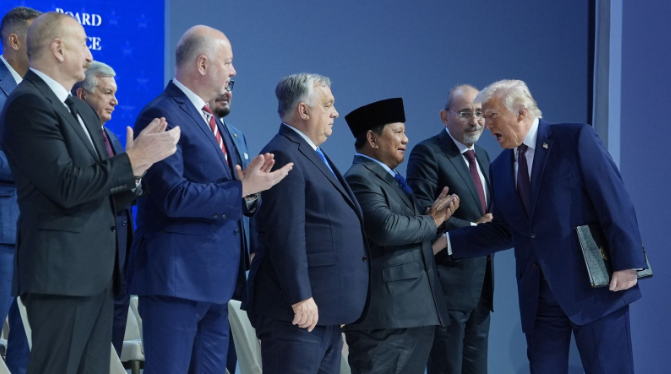
(CNN) US President Donald Trump is struggling to attract western allies to his “Board of Peace”, but so far he has garnered the support of Middle Eastern monarchs, the man known as Europe’s last dictator and at least one leader wanted for alleged war crimes.
Trump has invited dozens of countries to join the board that seeks to resolve global conflicts, but its remit has alarmed several US allies, as has the US leader’s comment that it “might” replace the United Nations.
The board, indefinitely chaired by Trump, was originally conceived as a limited body tasked with overseeing the reconstruction of the Gaza Strip, which was devastated by Israel’s two-year war. However, its purpose has expanded to tackle conflicts the world over, and the charter draft, which was sent along with the invitations to join, does not even reference Gaza.
US adversaries Russia and China, as well as longtime repressive state Belarus, are among those invited to join the board, which is offering permanent seats for $1 billion each. European allies, oil-rich Arab states of the Persian Gulf, former Soviet republics and even the pope have also received invitations to join.
But a signing ceremony on the sidelines of the World Economic Forum in the Swiss resort of Davos was attended by fewer than 20 countries — mostly from the Middle East, Asia and South America — far fewer than the roughly 35 that a senior administration official predicted to reporters earlier this week. European leaders were visibly absent. The only Western European nation represented was Hungary, one of Russia’s closest allies in Europe.
Trump had initially floated the Board of Peace as part of a second phase of the US-brokered 20-point Gaza ceasefire plan in September.
The United Nations Security Council backed the plan in November — giving it international legitimacy — with a mandate for the board to oversee the demilitarization and rebuilding of Gaza.
But Trump had longer-term plans. The charter draft, obtained by CNN, describes the Board of Peace as an “international organization” promoting stability, peace and governance “in areas affected or threatened by conflict.”
Trump will serve as chairman of the board indefinitely, according to the charter, possibly holding the post beyond his second term as president.
The Board of Peace will sit above a “founding executive board” that includes Trump’s son-in-law Jared Kushner, Secretary of State Marco Rubio, special envoy Steve Witkoff and former British prime minister Tony Blair.
Speaking at the Davos ceremony on Thursday, Kushner acknowledged at the outset that “peace is a different deal than a business deal.”
Kushner said the administration’s “master plan” for redeveloping Gaza does “not have a plan B” beyond its multi-step effort to end the war and transform the region.
The president’s son-in-law stressed that much of that plan relies on Hamas demilitarizing. He vowed that the US is “going to enforce” that part of the ceasefire agreement without providing specifics.
But a series of slides featuring composite imagery of futuristic-looking high-rise buildings, new roads and energy infrastructure previewed another vision.
Trump called Gaza a “beautiful piece of property” and said he is a “real estate person at heart” when talking about reconstruction of the war-torn Strip.
The United Arab Emirates, Saudi Arabia, Egypt, Qatar, Bahrain, Pakistan, Turkey, Hungary, Morocco, Kosovo, Armenia, Argentina and Paraguay have accepted Trump’s invitation, as have Central Asian states Kazakhstan, Mongolia and Uzbekistan, and the Southeast Asian nations of Indonesia and Vietnam.
Israel’s Benjamin Netanyahu is also on board, even though he has fumed at the inclusion of Turkish and Qatari officials on the Gaza executive board and faces an arrest warrant from the International Criminal Court.
There was no Israeli representative on the stage for the Board of Peace ceremony, although Israeli President Isaac Herzog was in Davos. Netanyahu did not attend.
Armenia and Azerbaijan, which signed a US-brokered peace agreement last year in a deal that would give the US exclusive development access to a critical transit corridor in the region, have also agreed to participate.
Belarusian leader Alexander Lukashenko, often described as Europe’s last dictator and a key ally of Russian President Vladimir Putin, has signed up.
“I have some controversial people on it,” Trump told CNN, referring to his claim that Putin has agreed to join. The Russian leader has yet to confirm his decision, although he has floated using Russian assets frozen in the US to pay the $1 billion fee for a permanent seat. Putin’s potential inclusion has raised alarm about how a country actively waging war could be involved in an effort to secure peace.
Witkoff and Kushner are due in Moscow on Thursday for talks with Putin that will focus on a peace deal with Ukraine.
Canadian Prime Minister Mark Carney, who has repeatedly railed against Trump ripping up the global “rules-based order” and imposing punishing tariffs, intends to join with conditions. He said the details, including financial ones, have yet to be worked out.
Putin and Carney were not in attendance at the Davos ceremony on Thursday.
Some nations have not committed either way, while others have rejected invitations.
Britain said it would not sign up due to concerns about Russian involvement.
British Foreign Secretary Yvette Cooper told the BBC on Thursday that her country would not be one of the signatories “because this is about a legal treaty that raises much broader issues.”
“We do also have concerns about Putin being part of something, which is talking about peace, when we have still not seen any signs from Putin that there will be a commitment to peace in Ukraine,” she said.
France and Norway have declined, in part citing questions about how the Board of Peace would operate in conjunction with the UN.
China confirmed that it was invited but has not said whether it will join. A Foreign Ministry spokesperson said Wednesday that China “will stay firmly committed to safeguarding the international system with the UN at its core.”
Ukrainian President Volodymyr Zelensky said it was difficult to see being “together with Russia in any council.” The issue, he said, “is that Russia is our enemy, and Belarus is their ally.”
Italian Prime Minister Giorgia Meloni said there could be constitutional issues with joining, and she declined to attend the signing ceremony. Irish Foreign Minister Helen McEntee said she would give the invitation “careful consideration.”
https://www.cnn.com/2026/01/22/world/trump-board-of-peace-explainer-intl-hnk