People these days tell many stories about energy and the 21st century energy transition. Some promote or are at least enthralled by the merits of a particular technology. For example:
-
- “Wind, water, and solar can power the world by 2050”
- “Geothermal technology is improving and can provide 20% of electricity by 2030”
- “Renewables and battery storage (BESS) can power any grid”
- “There is enough naturally occurring hydrogen in the ground to power humanity – we just have to drill in the right place”
Such stories are readily refuted with a little dispassionate analysis based on basic scientific, engineering, societal, and financial principles. There is no energy technology – none – that is the best or only answer everywhere.
That said, humanity’s energy demands are constantly increasing, and our traditional energy resources are finite, so energy systems are evolving – becoming more diverse and leveraging new and refined technologies. Compared to even 10 years ago, wind and solar generate electricity far more efficiently, geothermal systems are seeing significant advances, and battery storage is far cheaper and more efficient. On the other hand, exploration for naturally occurring (geologic) hydrogen is in the very early stages, and there has been no commercial discovery – so not every great idea will be a practical or commercial success.
All this science, engineering, investment, and hard work make it abundantly clear that the energy systems of the future will evolve from today’s systems. But they will not be all that much different in the short to medium term, because large-scale change takes time. There is no simple answer – energy transition is and will continue to be the product of many new and/or better technologies, methods, and social/geopolitical factors.
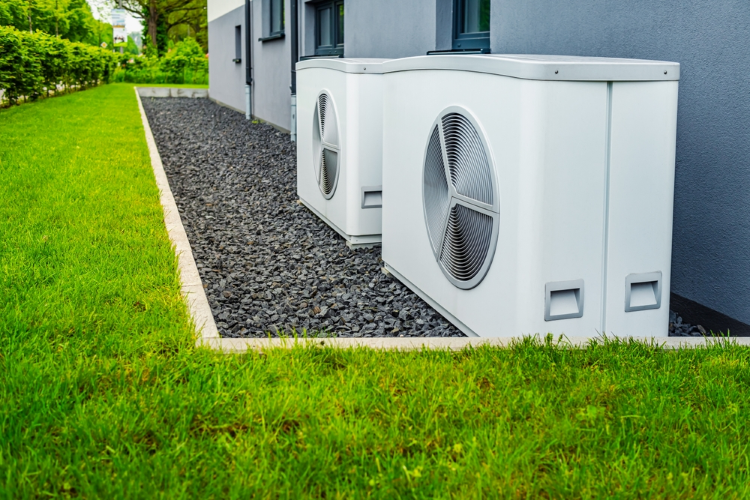
As an example, let’s look at one rapidly emerging technology – heat pumps. Heat-pump technology is well established and immensely useful, as described by Natural Resources Canada:
“A heat pump is an electrically driven device that extracts heat from a low temperature place (a source), and delivers it to a higher temperature place (a sink). As energy is extracted from a source, the temperature of the source is reduced. If the home is used as the source, thermal energy will be removed, cooling this space. This is how a heat pump operates in cooling mode, and is the same principle used by air-conditioners and refrigerators. Similarly, as energy is added to a sink, its temperature increases. If the home is used as a sink, thermal energy will be added, heating the space. A heat pump is fully reversible, meaning that it can both heat and cool your home, providing year-round comfort.” Heating and Cooling With a Heat Pump
Most heat pumps use one of two sources of thermal energy. Air-source heat pumps draw heat from the outside air during the heating season and reject heat outside during the summer cooling season. Ground-source heat pumps use the earth, ground water, or both as the source of heat in the winter, and as a reservoir to reject heat removed from the home in the summer. Air-source heat pumps are much more common, because they just need access to outside air, whereas ground-source heat pumps circulate fluids through underground pipes, requiring a lot more money and hardware to install.
Both air-source and ground-source heat pumps are very energy efficient, because they use less energy (electricity) to transfer heat from one place to another than it would take to actually generate that heat in the first place. But the absolute efficiency depends in large part upon the temperature difference between heat source and sink. That is, it takes a lot more work to heat a home by extracting heat from very cold outside air than from air that is not so cold. So there are limits: air-source heat pumps work well in moderate climates, but are less capable where winters are cold.
Orennia built a map to illustrate where heat pumps are being installed in North America today (Figure 1). It provides a great example of how specific energy-related technologies such as heat pumps can be a viable solution in some areas and not in others.
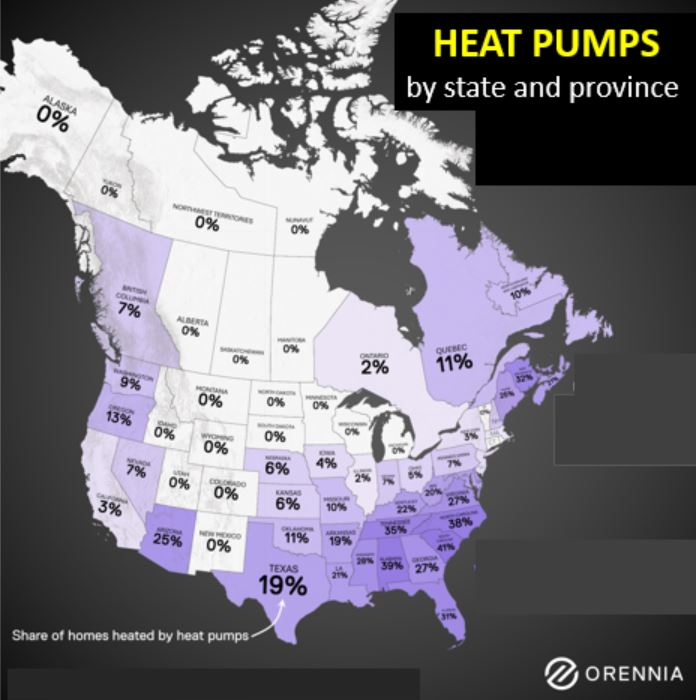
Figure 1 – Share of homes heated by heat pumps in North American states, provinces, and territories based on data from the U.S. Energy Information Administration, Natural Resources Canada, and Harvard Law. Where Heat Pumps Are Being Adopted Across North America
What the map shows us:
-
- Where competing against expensive heating oil in maritime-moderated climates on the east coast of Canada and the United States, heat pumps are definitely in the game.
- Where it never gets very cold in winter but is hot in the summer – in the south and southeastern U.S. – heat pumps can provide both heating and air-conditioning for many homes, as long as electricity is reasonably priced.
- Where it is colder but electricity is cheap and abundant, there is room for heat pumps to grow, such as in the U.S. Pacific Northwest, and Canadian provinces British Columbia and Quebec.
- But where it gets really cold in winter (-20C or colder), and particularly where there is well-established natural gas infrastructure, few people are willing to take a chance on heat pumps. Last year, I had to replace my home heating system in Calgary, where it is routinely below -20C (including at the time of publishing this article) and hits the mid minus-30s at some point most winters. A bit of research demonstrated that high-efficiency natural gas furnaces were by far the best answer in terms of both price and reliability. Installing even the best air-source heat pump would require also installing natural gas-fired backup heating, while a ground-source heat pump was not even a consideration for retrofitting a home on a moderate-sized suburban lot.
As I said, however, there is no absolute. Even though the map shows 0% heat pump installations in Alberta, I have heard from a few people that do have them as part of larger systems that include natural-gas-fired backup. But the prospects for significant growth here are poor – Alberta has centuries worth of natural gas resources, well-established natural gas infrastructure, and an electrical grid built on natural-gas-fired generation. Meanwhile, growing demand for electricity to power data centres, electric vehicles, and other new applications should make us wary of making critical heating needs dependent solely on electricity.
In conclusion, heat pumps – a well-established, effective, and efficient energy technology – are being used in up to 40% of homes in places where they are well suited. And the proportion will likely grow as the technology improves and people replace their heating systems over time. But there are many white spots (0% heat-pump adoption) on the map, and those are not going to change much in the foreseeable future, because even the best heat pumps do not offer what people need in those places.
The same is true for every other energy technology, old and new. Diversity is the key. Optimal applications are different in different places. One size never fits all.
(Brad Hayes, BIG Media Ltd., 2025)