
In a publicly funded healthcare system already strained by wait times, staffing shortages, and an aging population, the emergent normalization of medical assistance in dying (MAiD) was never going to remain constrained.
Once a procedure enters the bureaucratic and budgetary machinery, incentives emerge – quiet, structural, unspoken. And denied. What began as a compassionate response to irremediable suffering becomes entangled with the cold, objective logic of resource allocation. This is the financial reckoning Canadians have been reluctant to confront directly.
Canadians rightly demand prudent use of tax dollars. Presumably, this includes the allocation of healthcare dollars. Objective use of dollars would include bureaucratic-justified analysis, goals, and policy decisions rendered more palatable, guided by front-line hands, kindness, and care to help achieve those goals.
Early analyses by the Parliamentary Budget Officer and subsequent modelling estimated explicit and meaningful per-patient cost savings when MAiD replaces prolonged end-of-life care, particularly in cases involving extended hospital stays, palliative services, or long-term residential support.
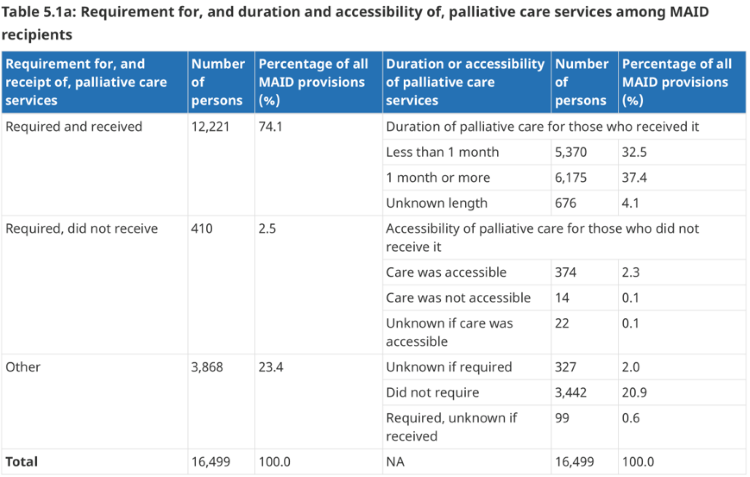
In a single-payer system in which every dollar spent on one patient is a dollar unavailable for others, these are not abstract savings. They represent real budget relief, captured in line items, reviewed by planners, and enacted by policymakers. This relief is operationalized by front-line workers skilled in the comportment of care, fluent in its language, committed to the spirit and operationalization of that language: all in all, the undertakers of mercy. As MAiD volumes scaled to more than 16,000 provisions annually, the economic signal strengthened. Buried in the Sixth Annual Report, it is important to know that 23.4% of MAiD provisions in 2024, 1. neither required and received, nor 2. required and did not receive palliative care.
Efficiency, framed as harm reduction and dignity, quietly aligns with rational, fiscal prudence.
The signal perverts incentives. Charlie Munger had much to say on incentives. Deep Throat counselled following the money.
Physicians and institutions operate under budget pressure. Families face emotional and financial exhaustion. Patients themselves, especially those citing poverty, inadequate housing, or the feeling of being a burden, enter the conversation carrying the weight of systemic scarcity.
In other places, lived experience is celebrated preeminent and aspirational. Here, it is enclosed as diminishment and destiny. Reports have documented cases where MAiD was discussed alongside, or even before, fuller exploration of treatment or support options. In one widely discussed instance, a patient with chronic but treatable conditions cited inability to afford better housing as a contributing factor. Surely this is a coincidental off-ramp to the affordable housing crisis. Certainly nobody in government or government-enlisted consultancies would do such cost-benefit analysis. Certainly.
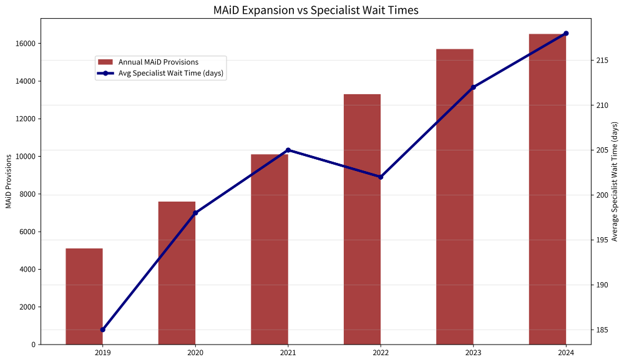
Where the System Moves Quickly vs. Where It Does Not: MAiD vs. Specialist Wait Times
 Sources:
1. Health Canada MAiD Reports for provisions.
- CIHI (Canadian Institute for Health Information) wait times data – specialist waits have remained stubbornly high (often 6+ months) despite MAiD scaling.
- Provincial health reports (Ontario, B.C.).
The therapeutic language of “autonomy” and “choice” smooths these interactions, but it cannot erase the underlying asymmetry: the state that struggles to provide robust living supports and timely specialist healthcare can deliver death with incomparable efficiency: euthanasia’s black standard juxtaposes healthcare’s gold.
Here, the Big Mother dynamic reveals its impressive, material edge.
The nurturing, therapeutic state presents itself as the compassionate provider that anticipates needs and relieves burdens. Yet when care becomes expensive, logistically difficult, or inconvenient, the same nurturing logic offers the terminal release from burden as the responsible, even loving, option. Suffering, no longer merely medical, is reframed as an unjust imposition on both the system and the individual. The safety-industrial complex expands its remit into new territory: identifying vulnerabilities, documenting distress, and offering the eventual, beneficial administrative solution.
Like water seeking its level, compassion that was once channeled toward investments in palliative excellence, housing, and community supports, finds its cheaper, baser outlet. That calculus bodes ill for future palliative and associated investments scored against MAiD in Canadian metrics. It bodes well for strained healthcare budgets, and best for rising deathcare budgets.
This is not conspiracy.
It is institutional gravity.
In resource-constrained environments, procedures that reduce long-term costs have a propensity to normalize, then expand. Few would quarrel over public, fiscal responsibility. To deny that point is to occupy another planet. My less educated, but no less intelligent elders were speaking of this exact scenario in the mid-1970s at family barbecues, doing the math on packs of du Maurier. Healthcare actuaries have done the math longer on more sophisticated instruments.
Hospital administrators manage bed turnover. Provincial budgets reconcile accounts. The original Sue Rodriguez-era vision – rare, exceptional, safeguarded, dignity-driven – did not anticipate how quickly the procedures would scale into a growth category with its own momentum, training programs, and quieted performance metrics. Termination, sold as harm reduction, creates space for greater efficiency, and greater efficiency is sold as the most humane path.
Few gods dare challenge efficiency.
We have seen this pattern before in other eras and domains in which good intentions, temporary and final solutions meet Tayloristic optimization.
The parallels to COVID sharpen the point. During the pandemic, the state’s “collective care” logic justified extraordinary measures, including restrictions that devastated small businesses, mental health, and family connections – social upheavals that continue to reverberate.
With MAiD, however, the therapeutic impulse turns inward. Reduced investment in living infrastructure can be reframed from a policy failure requiring urgent correction. Instead, the compassionate exit expands to fill systemic gaps, and the policy expansion can be inverted to success. Wait times for healthcare versus “deathcare” tell their own story: the 10-day reflection period has itself been challenged as unnecessarily cruel. The system that delays surgeries and specialists can move with notable speed when the outcome is permanent, and the line item is written off. In aggregate, pernicious cost centres move from liabilities to assets. Cups runneth over.
My time as a long-term care therapist in the late 1980s and early 1990s at Colonel Belcher Hospital in Calgary offered a different model. Veterans received compassionate, non-lethal accompaniment through decline and dementia. Dignity was preserved through care, not its withdrawal. That spirit feels increasingly distant in a system today in which efficiency metrics and budgetary relief exert their own gravity.
We know what happens when gravity collapses upon itself.
MAiD’s true reckoning demands honesty, transparency, and plain language around the F=ma of incentives.
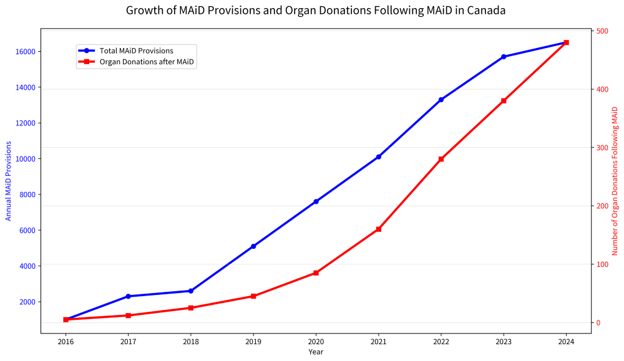
Expanding MAiD while palliative care remains patchy and social supports threadbare is not neutral policy. It tilts the field. Organ donation protocols layered onto MAiD raise further uncomfortable questions about secondary markets and subtle inducements. Did Canada, in banning international organ trafficking in 2022, unintentionally open a domestic loophole with the same features now given air cover by MAiD? Do domestic actors fill a void formerly filled by international organ traffickers, competition free? There is good money in livers and kidneys as a first-order business model. There are network effects to open up second-order business models. This paragraph should cause some squirming by readers, though it will be denied by some, and forgotten by many.
The nurturing dialect masks these tensions: what sounds like expanded autonomy can function as managed abandonment when living options are underfunded. The slack is picked up elsewhere. Whether by design, opportunity, or consequence matters not.
MAiD Provisions and Organ Donations Following MAiD in Canada (2016–2024)
Sources:
1. Health Canada MAiD Annual Reports (2016–2024) for provisions (official figures: 16,499 in 2024).
- CMAJ studies and provincial transplant data (e.g., Quebec reports showing rise from ~5% to 14%+ of deceased donors from MAiD cases).
- Blood.ca / Canadian Organ Donation data summaries.
A humane society must separate the relief of suffering from the elimination of the sufferer. This requires ring-fencing MAiD into its narrowest, best-justified cases while aggressively investing in the supports that make living viable. In the absence of deliberate guardrails, financial logic and care-culture language will continue to impress the efficient resolution.
The fence of prohibition was torn down in the name of compassion; repairing the boundary around what constitutes genuine care (rather than convenient exit) is an uncomfortable but undeniable path if we wish to preserve both dignity and the will to live through difficulty.
The financial reckoning is not merely about dollars. It is about what kind of society we become when nurturing instincts are filtered through single-payer constraints, bureaucratic incentives, and new lexicon to enable those incentives and protect them from criticism.
Big Mother’s gentle hand, offering kindness-wrapped release, claims a ledger that quietly redefines the value of persistence, respect, and dignity itself.
(Richard LeBlanc – BIG Media Ltd., 2026)