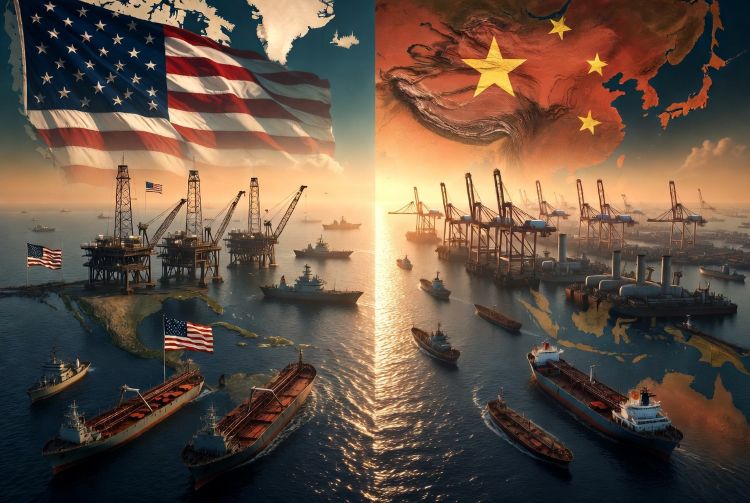
As the United States and the People’s Republic of China (PRC) hurtle toward an era of intense great-power rivalry, a fundamental shift in the global balance of power is under way. For decades, China has leveraged its near monopoly on critical minerals to exert strategic influence over the West.
Today, under its 47th president (POTUS 47) or President Donald Trump’s second term, the U.S. is aggressively countering that leverage by weaponizing its dominance in global energy markets. By systematically cutting Beijing off from heavily discounted crude oil supplies from rogue dictatorial regimes and forcing purchases in USD rather than RMB, the Trump administration is reshaping the economic battlefield.
This essay examines how Trump’s Donroe Doctrine, decisive military-diplomatic actions in Panama, Venezuela, and Iran, and renewed defence mobilization are designed to restore U.S. primacy.
The Donroe Doctrine is the informal name for POTUS 47’s modern expansion of the early 19th-century U.S. Monroe Doctrine. It asserts dominance across the Western Hemisphere, treating the Americas as its exclusive sphere of influence and actively working to expel or severely limit the economic, military, and political footholds of adversarial powers — especially China, Russia, and Iran — through tariffs, sanctions, diplomatic pressure, and direct military action.
What began as confrontation under POTUS 45 has evolved into a comprehensive strategy aimed at neutralizing the PRC’s most potent economic advantages, while exposing the limits of its military technology and financial ambitions.
The May 16, 2026, meeting of Trump and Chinese President Xi Jinping in Beijing may prove a defining moment in this unfolding contest.
Under POTUS 45, U.S.-PRC relations became increasingly confrontational.
Trump repeatedly accused Beijing of currency manipulation and imposed tariffs on more than $360 billion of Chinese imports to address massive trade imbalances. He criticized the PRC for its lack of law enforcement against fentanyl precursor exports to the U.S.
Relations deteriorated further when China concealed critical information about the SARS-CoV-2 virus originating from the Wuhan Institute of Virology and hoarded personal protective equipment in the early stages of the outbreak, as the World Health Organization delayed declaring a global pandemic.
These actions, combined with forced technology transfers from western corporations operating in the PRC, intellectual property theft, and aggressive militarization in the South China Sea, convinced POTUS 45 and many U.S. policymakers that the era of strategic engagement was over.
Beijing was now a determined systemic rival seeking to displace American primacy.
Much of POTUS 47’s stance on global trade (including aggressive tariffs) and his assertive foreign policy — exemplified by the Donroe Doctrine and criticism of NATO members’ failure to meet defence spending commitments — was surely shaped in part by the Department of Justice lawfare he faced under POTUS 46 (Joe Biden) and two assassination attempts against him in 2024.
Trump seems to view the botched 2021 Afghanistan withdrawal that left behind over $7 billion USD in advanced U.S. military weapons for the Taliban, the 2022 Russian invasion of Ukraine, and the United Nations’ extensive support for migrants under POTUS 46 as actively aiding the invasion of the United States.
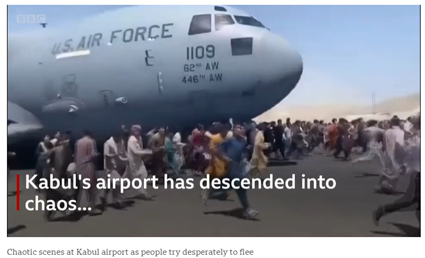
BBC coverage of USAF’s hasty retreat from Afghanistan in 2021.
POTUS 47 also highlighted the PRC’s offshoring of fentanyl production to Mexico and its failure to honour commitments secured under his first term, including increased U.S. imports, and action on fentanyl.
To Trump, these were elements of a concerted effort by POTUS 46 Democrats and globalist multilateral agencies to weaken the U.S. and accelerate the movement of power toward the PRC.
This conviction has driven his second-term economic nationalism and hemispheric assertiveness.
The Trump administration viewed the U.S. military-industrial complex and taxpayer expenditures under POTUS 46 — particularly the massive expansion of weapons provided to Ukraine — as an existential threat when combined with the PRC’s control over military-grade critical mineral supply chains.
Billions in U.S. aid depleted America’s effective magazine depth, while delivering large economic windfalls to China’s critical minerals processing sectors.
Between POTUS 45 and POTUS 47, the PRC increasingly weaponized its near monopoly over these materials through export restrictions.
POTUS 47 responded with far more aggressive immediate action: rapid permitting reform, strategic stockpiling, friend-shoring, and domestic investment to insulate the United States from this vulnerability. Unlike the foundational steps of the first term, POTUS 47 treats critical minerals as an urgent national emergency requiring whole-of-government mobilization.
The Donroe Doctrine delivered swift results in 2025 and 2026.
In Panama, Trump took action to reassert U.S. control over the canal.
The U.S. State Department pressured Panama to prohibit PRC ownership of canal infrastructure. BlackRock led a major private-sector consortium that shifted control of the strategic Balboa and Cristóbal ports away from Hong Kong/Chinese-linked operators, aligning with broader efforts to reduce PRC economic influence in the region.
Trump also declared major drug smugglers as terrorists and ordered the U.S. Coast Guard and Navy to attack trafficking vessels en route to U.S. territorial waters. The most dramatic move came in early 2026 with the U.S. military operation that captured Venezuelan President Nicolás Maduro, allegedly justified by his narco-terrorism, alliances with U.S. adversaries, and regional destabilization.
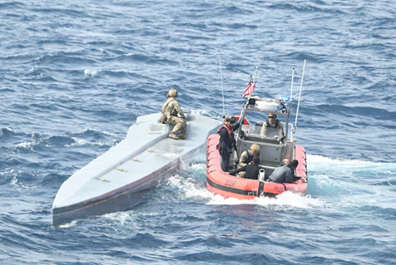
Coast Guard Cutter Tampa crew members intercept suspected drug smuggling vessel in the Pacific Ocean – Operation Pacific Viper, 2025.
China had become the single largest buyer of U.S.-sanctioned, heavily discounted Venezuelan heavy crude oil.
Following Maduro’s capture and arrest, Venezuela agreed to sweeping concessions: U.S. control over oil export revenues (giving Washington veto power over buyers and pricing), transfer of 30-50 million barrels to the United States and opening its state-owned oil corporation to U.S. companies.
For the PRC, this meant the loss of preferred discounted supplies and RMB-settled deals.
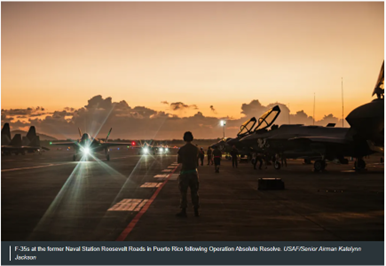
USAF F-35 stealth fighters operating out of Puerto Rico following Operation Absolute Resolve.
Thus, the U.S. gained revenue oversight, hemispheric energy influence, and leverage to redirect Venezuelan crude oil flows away from the PRC, or requiring the PRC to pay no-discount internationally priced crude oil in USD.
The successful U.S. operation demonstrated that PRC defensive technologies sold to Venezuela as capable of tracking and interdicting U.S. F-35 stealth fighters were ineffective against American aerospace capabilities, damaging the credibility of Chinese military exports.
The most crucial example of POTUS 47 exerting U.S. military power for energy leverage ahead of the May 16 Trump-Xi summit are the 2025 and 2026 U.S.-Israeli Defence Force (IDF) aerial campaigns against Iran.
The background to these military operations included Trump’s 2018 sanctions that forced Iran to sell crude at deep discounts on the black market.
Under POTUS 46, China became the single largest benefactor, buying 80–90% of Iran’s black-market exports at $8-20 USD per barrel below market, often in RMB.
During this time, Iran’s ballistic missile fleet and military-industrial complex grew heavily dependent on PRC technology, turning Iran’s Islamic Revolutionary Guard Corps (IRGC) into an effective Chinese proxy in the Persian Gulf. The Strait of Hormuz remains Beijing’s immense geopolitical Achilles’ heel.
U.S.-IDF operations in 2025 and 2026 have shown U.S. aerospace superiority, disrupted Iranian exports, and highlighted the vulnerability of China’s energy supply lines.
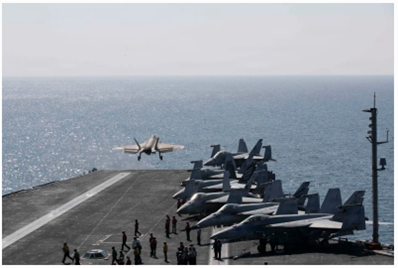
An F-35C Lightning II, attached to Marine Fighter Attack Squadron (VMFA) 314, launches from the flight deck of Nimitz-class aircraft carrier USS Abraham Lincoln (CVN 72) in support of Operation Epic Fury on March 3. (U.S. Navy photo)
Collective actions in Panama, Venezuela, and Iran are creating immense U.S. geopolitical leverage over the PRC, especially regarding access to discounted crude and dictatorial oil supplies.
If Iran follows Venezuela’s path of U.S.-controlled revenue and redirected flows, Beijing will lose two major sources of cheap oil paid for in PRC yuan (RMB).
The PRC’s Strategic Petroleum Reserves are finite, and the clock is ticking as Venezuelan and Iranian imports vanish.
Recent POTUS 47 executive orders granting short-term relief on Russian Ural crude sanctions are calibrated to further restrict discounted authoritarian oil available to China. This, in turn, increasingly forces Beijing to once again buy at full market prices, largely in USD, undermining RMB internationalization.
The implications for the PRC include higher energy costs, reduced flexibility, and a narrowing window to challenge USD dominance in crude oil markets.
Both nations are preparing for potential direct great-power conflict.
U.S. defence spending rose under POTUS 45, surged on Ukraine aid under POTUS 46, and is now expanding dramatically. POTUS 47 has announced a 50% increase in Pentagon spending for FY2027 and is pressing the military-industrial complex for massive reinvestments in production capacity, including agreements with non-traditional manufacturers — a scale and practice last seen in the Second World War.
The U.S. is bolstering the First Island Chain with long-range ballistic missiles to the Philippines and reactivation of WWII airfields within the Indo-Pacific region.
In contrast, the PRC’s nuclear armament rates are the world’s fastest, and its blue-water naval shipbuilding has surpassed even the U.S.’s WWII pace. It is clear that the PRC is preparing for large-scale military confrontation with the U.S.
The May 16 meeting in Beijing is critical.
While Trump has rapidly built immense energy leverage over the PRC, China retains supreme control over critical minerals essential to the U.S. military-industrial complex. The sides will ideally reach mutually satisfying concessions – on energy security for China, and critical minerals access for the U.S.
The relationship remains precarious.
Success could stabilize competition; failure risks open confrontation.
(Joseph Fournier – BIG Media Ltd., 2026)