Four years on, the courts have ruled, the money is gone, and not one person has answered for any of it.
By Bruce Scholl — Unscrew the News
A wound closes when you take the dirt out of it. Leave the dirt in and it festers, and it keeps festering no matter how many times you tell the patient he’s healed.
That is where Canada sits in August 2026. We are five and a half years past the first shot going into the first arm and four and a half years past the trucks rolling into Ottawa, and the official position of the Government of Canada — under a new Prime Minister, with a new cabinet — is that nothing needs to be taken out.
No inquiry. No accounting. No apology. Just a slow, quiet effort to make everyone stop asking.
It isn’t working. Here’s why.
Part One: The Record Against the Rhetoric
Start with the thing people are still not allowed to say plainly: the public messaging was not the science. It was a product built on top of the science, and the two were never the same document.
On December 10, 2020 — the week the first doses arrived — the Public Health Agency of Canada announced the Vaccine Injury Support Program. In the same news release, the government told Canadians that the chance of a serious adverse reaction was “extremely rare — less than one in a million,” and that a compensation program was being built because government has “a duty to help if this occurs.”
Hold both halves of that in your hand, because they do not fit together. If the risk is genuinely one in a million, you do not need a $75 million compensation fund with a third-party claims administrator and fifty contracted physicians. You build that because you expect claims. The government built it because they expected claims. They simply told the public something different.
That is the pattern, and once you see it you cannot unsee it.
Take transmission. Canadians were told — from podiums, in ad buys, by premiers and public health officers and the entire broadcast apparatus — that getting vaccinated protected other people. That was the moral engine of the whole mandate structure. It is what made a personal medical decision into a civic obligation, and it is what made the unvaccinated into a category of person rather than a person who declined a product.
The protection against transmission was real early and it faded fast, and by the time Omicron arrived it was thin and short-lived. That was known inside the institutions well before it was conceded outside them. And here is the part that should end the argument: the retraction never came at the volume of the claim. There was no address to the nation. No campaign. No apology to the nurse who lost her licence or the truck driver who lost his route or the grandfather who was told he was a danger to his own family at Christmas. The claim was broadcast on every screen in the country. The correction was published in a journal.
You do not get to make a case to eight million people and then correct it to eight hundred.
“Safe and effective” was never a finding. It was a slogan, and it was doing a job that findings do not do: it was foreclosing a question. A finding invites scrutiny. A slogan punishes it. And for three years in this country, scrutiny was the thing being punished — by licensing colleges, by employers, by banks, by broadcasters, and by neighbours who had been given permission.
Part Two: The Unaccountable
On January 16, 2026, the Federal Court of Appeal of Canada released its decision in the Emergencies Act cases.
It was unanimous. The panel included Chief Justice Yves de Montigny. In a move the court almost never makes, the judgment was signed simply “The Court” — the institutional equivalent of standing up together.
The finding: the federal government’s February 2022 invocation of the Emergencies Act was unreasonable and outside its legal authority. Cabinet did not have reasonable grounds to believe a threat to the security of Canada existed. The protests, the court said, were disturbing and disruptive — and fell well short of a threat to national security. There was no evidence that the lives, health or safety of the people of Ottawa were endangered.
It went further. The emergency regulations violated section 2(b) of the Charter — freedom of expression — because they were overbroad and drew no line between lawbreakers and peaceful bystanders. And the Economic Order, which compelled banks to disclose customers’ personal information and freeze the accounts of designated people without a warrant, without judicial authorization, without due process, violated section 8: the right to be free from unreasonable search and seizure.
Two hundred and fifty-seven accounts were frozen. One hundred and ninety-six people arrested. One hundred and ten charged.
And then, five days ago, it got worse
On August 17, 2026 — seven months after the Federal Court of Appeal ruled the whole thing unconstitutional — Blacklock’s Reporter published new records showing where that list actually went.
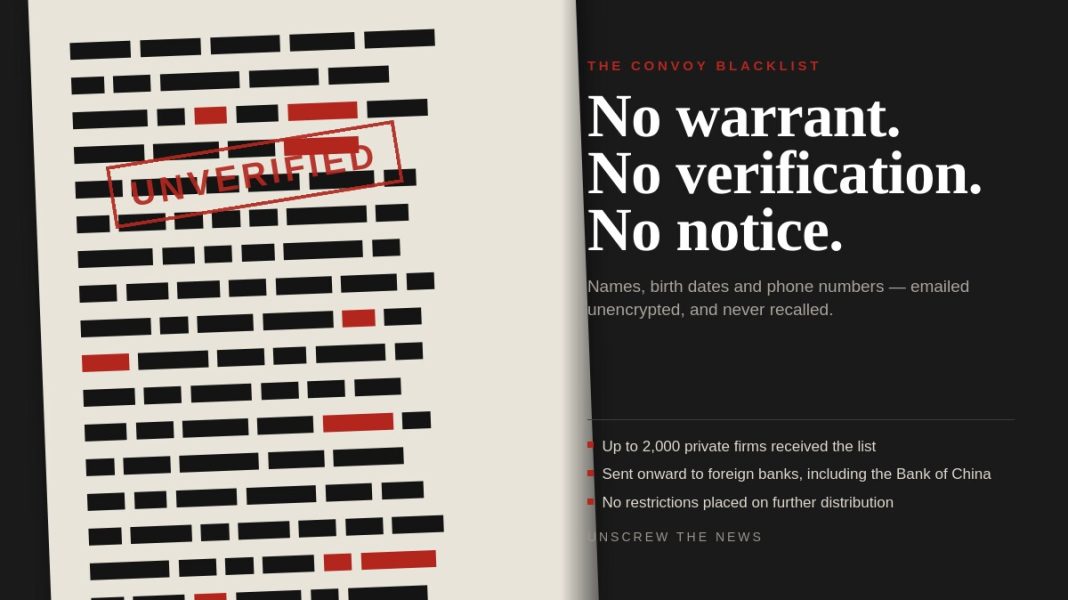
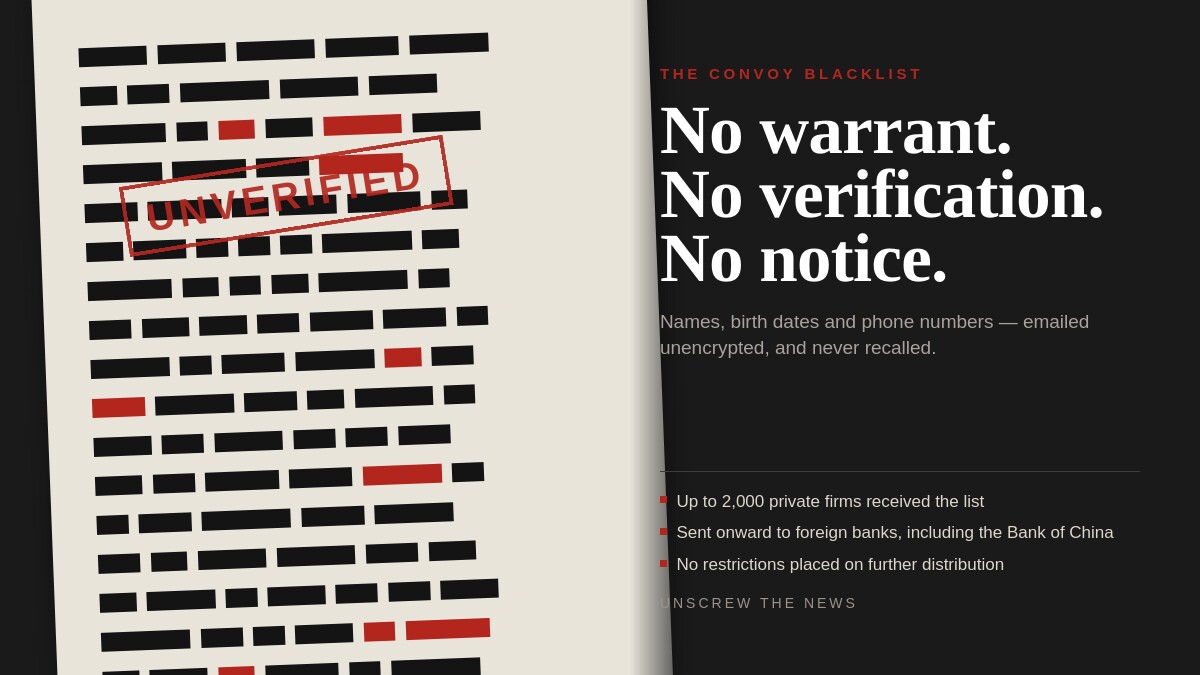
The blacklist originated with the RCMP. It contained names, birth dates, telephone numbers and other personal information. According to the records, it was distributed by unencrypted email.
It did not stop at the banks. It went to industry bodies and regulators — the Canadian Bankers Association, the Mutual Fund Dealers Association, the Canadian Securities Administrators, the Ontario Securities Commission. And Ontario regulators then forwarded it onward to somewhere between one thousand and two thousand brokerages and firms.
No restrictions were placed on further distribution. None. Once it left the RCMP, the list was loose.
This was already known to have crossed borders. A 2023 Inquiry of Ministry tabled in the Commons confirmed the RCMP sent the blacklist to the Canadian arms of foreign banks — the Bank of China, the State Bank of India, BNP Paribas, Citibank, Habib Bank of Pakistan, ICICI, Mizuho, Wells Fargo, Hana Financial Group of South Korea. Chrystia Freeland’s office authorized the blacklisting. At the time, Freeland told the country to be very, very careful to get the facts exactly right, and said the RCMP had given financial institutions the names of leaders, organizers, and people whose trucks were in the blockades.
Now compare that to what her own assistant deputy finance minister, Isabelle Jacques, told a parliamentary committee in 2023 about the names on the list: there was no verification, and no follow-up.
So put the whole thing together, because this is the sentence that matters:
The Government of Canada compiled an unverified list of citizens’ names, birth dates and phone numbers, distributed it by unencrypted email to as many as two thousand private financial firms and to foreign banks including the Bank of China, placed no limits on where it went next, and then never told the people on it.
There has been no public accounting of what happened to anyone after their name landed in those inboxes. No notification. No recall of the list. No way for a Canadian to find out today whether a brokerage in Toronto or a compliance desk in Beijing still has a file with his name in it because he honked a horn or hauled a load in February of 2022.
That is not an emergency measure. That is a permanent record, created without a warrant, of people whose only offence was political.
And here is the detail that tells you everything about how the decision was actually made: when the provinces were consulted a few hours before invocation, only Ontario, British Columbia, and Newfoundland and Labrador appeared to support it — and only on a time-limited basis. The rest of the country, including this province, was not with them. They did it anyway.
That ruling upheld Justice Richard Mosley’s 2024 Federal Court decision, which had found the invocation lacked justification, transparency, and intelligibility. Mosley — a twenty-one-year veteran of that court, no one’s idea of a firebrand — went out of his way to say he had sympathy for the people around that cabinet table, and that had he been there in the moment he might have agreed with them. He ruled against them anyway, because the law is the law and the threshold is the threshold.
Two courts. One retired judge who wanted to agree with the government. A unanimous appellate panel. The same conclusion.
So what did Ottawa do?
On March 17, 2026, the federal government appealed to the Supreme Court of Canada.
Read that again. A new government, under a different Prime Minister, elected on the promise of turning a page, chose to spend more public money defending an act two courts have now called unlawful — rather than accept the ruling, compensate the people whose accounts were frozen without a warrant, and move on.
That is not a legal strategy. That is an institution refusing to be told no.
And notice what is not on the list. Nobody resigned. Nobody was demoted. Nobody lost a pension. The Emergencies Act was invoked unlawfully against Canadian citizens, their bank accounts were frozen without judicial authorization, and the total professional consequence to the people who ordered it is zero.
We were told the system has checks. The check ruled. The check was appealed.
Part Three: The Abandoned
Now go find the people at the bottom of all this.
The Vaccine Injury Support Program opened in June 2021. As of December 1, 2025 — the most recent public figures — 3,557 Canadians had filed claims. Four hundred and fifty-one were ruled inadmissible. Just over three thousand were sent for medical review.
Two hundred and fifty-two have been approved. Just over $21 million paid out.
Set that against the one-in-a-million line from December 2020 and do the arithmetic yourself.
Then set it against what the program cost to run. Oxaro, the private firm contracted to administer VISP, had received $56.2 million from Ottawa by early 2024 — at a point when it had paid out $11.2 million in compensation. More than four dollars to the administrator for every dollar that reached an injured Canadian. Additional tens of millions have been added since.
The program was so badly run that the Health Minister ordered an audit, and in April 2026 the Public Health Agency of Canada took administration back in-house — five years after handing it out, and only after years of public complaints from claimants who could not get a return call.
Those aren’t statistics. I’ve had them on this program.
Carrie Sakamoto, from the Lethbridge area, is the lead plaintiff in a proposed class action against the federal and Alberta governments, filed by Rath & Company in the Court of King’s Bench. She chairs community outreach for CanRise19 and spends her own time helping other injured people fill out the paperwork that failed her. She was on Episode 299 in a conversation we titled “Sorry, The Best That We Can Do Is Abandon You.” That title wasn’t ours. It’s what the system communicates to these people every single day.
Michelle Worton, a dental hygiene practitioner in Fort St. John and a CanRise19 co-founder, has been through the same appeals machinery. Leighton Grey KC is running two class actions out of Alberta — one for the unvaccinated, one for the injured. None of these people are anti-vaccine activists. Most of them took the shot. Many took it because they were told to, to keep a job, to board a plane, to see a dying parent.
They are the government’s own best-case scenario — people who complied, were harmed, and applied to the program built specifically for them. And the system’s answer, for years, has been silence and a case number.
From September 8 to 11 in an Ottawa parliamentary committee room, the Allison Inquiry will hear their testimony directly. Sakamoto speaks on day one. It is not a Royal Commission. It has no subpoena power. It is a group of parliamentarians and citizens doing the job the Government of Canada has refused to do for five years, because somebody had to.
Part Four: They Asked for Amnesty Before They Ever Confessed
Let me drop the reporter’s voice for a minute, because there’s a thing that doesn’t come through in court citations and claim statistics, and it needs saying plainly.
I am angry. Not disappointed. Not concerned. Angry.
And I am not a special case. There are millions of us in this country — people who lost jobs, businesses, licences, relationships, funerals, weddings, the last months with a parent. People who were called selfish by their own government on national television. People who did everything asked of them and got hurt anyway and then couldn’t get a phone call returned for four years. That anger is not a pathology to be managed by a communications strategy. It is the correct response to what happened, and the fact that it has not gone away in five years should tell the political class something about its size.
Instead, they tried something else.
On October 31, 2022 — with mandates still fresh, before a single inquiry, before a single ruling, before a single resignation — The Atlantic published an essay by Brown University economist Emily Oster titled “Let’s Declare a Pandemic Amnesty.”
The argument, in short: nobody knew anything, everyone was guessing, most people meant well, keeping score is holding us back, so let’s forgive each other and move on to fixing what’s broken. She allowed one carve-out — the deliberate liars, she said, could be left out of it.
It went off like a grenade, and it deserved to.
Because look at the shape of what was being proposed. Amnesty is not something you declare for yourself. It is something the injured party grants — and it comes after the confession, not instead of it. What was on offer in that essay, and in the softer version of it that has been running quietly through Canadian institutions ever since, was the reverse: absolution first, admission never.
Notice also who the “we” was. Not the fired nurse. Not the pastor. Not the woman whose account was frozen over a fifty-dollar donation. The “we” that needed forgiving and the “we” being asked to forgive were not the same people, and the amnesty only ever flowed one direction — upward, toward the people who gave the orders, away from the people who took them.
And the “we didn’t know” defence collapses on its own timeline. Grant the first three months. Genuinely — March to June 2020, nobody had a map, and I’ll extend real grace to anyone making calls in that fog. But mandates in this country ran into 2022. The federal travel ban on unvaccinated Canadians was still standing in June of that year. By then we knew about waning transmission protection. By then the injury claims were stacking up in a program the government had quietly built in December 2020 because it expected them. “We didn’t know” is a defence for the fog. It is not a defence for the eighteen months after the fog lifted, when the policies stayed and the enforcement got harder and the questions got you fired.
It wasn’t only an American conversation. Marco Navarro-Génie — who has sat across from me on this program several times — published “A Case Against COVID-19 Amnesty in Canada” in March 2024, making the point that Oster was the first notable voice but far from the only one, and that a whole class of people had discovered a sudden enthusiasm for moving on.
Here is the thing they still don’t understand. Most of us are not asking for revenge. We are asking for the ordinary consequences that apply to everyone else in this country. If a private business had compiled an unverified list of citizens’ names and birth dates and emailed it unencrypted to two thousand firms and the Bank of China, there would be prosecutions. If a private insurer had taken $56 million to administer a fund and paid out $11 million of it while claimants waited years for a phone call, there would be an investigation with subpoenas.
Do that. That’s all. Apply the rules that apply to us.
And to be plain about the terms, since amnesty keeps getting floated: there is a version of this that ends. It ends with an admission, an accounting, and consequences for the people who decided. Forgiveness is available in this country — genuinely, and I say that as a man who believes it’s required of me. But forgiveness follows repentance. It does not replace it. You cannot skip to the part where everyone feels better.
What Accountability Would Actually Look Like
Not a hashtag. Four specific things:
Drop the Supreme Court appeal. Two courts have ruled. Accept it, compensate the people whose accounts were frozen without a warrant, and put it in writing that it will not happen again.
Notify everyone on the blacklist. Every Canadian whose name, birth date and phone number was emailed to two thousand firms has a right to know it, to know who received it, and to have it recalled. The Privacy Commissioner should be ordered to compel it.
A real inquiry with subpoena power into pandemic decision-making — mandates, procurement, contracts, and the advice ministers actually received versus what the public was told.
Open the VISP books. Every claim, every denial, every administrative dollar, published. If the injuries are as rare as we were told, the government loses nothing by proving it.
Name the deciders. Not “the government.” The individuals who signed off. Accountability that stops at an institution isn’t accountability; it’s a shield with a maple leaf on it.
The dirt is still in the wound. It has been in there since 2021. Every year it stays, more Canadians conclude — reasonably, based on evidence — that the institutions running this country will not be held to their own rules by anyone but themselves.
That is a far more dangerous condition than any virus.
Let’s stay sane together. Keep your head on a swivel.
— Bruce