
Proponents of the idea that we (humanity, the biosphere, the Earth) are experiencing a climate crisis hold that our only salvation is to drastically reduce anthropogenic (human-made) greenhouse gas emissions – with the ideal solution being “net zero” emissions. Some even appear to feel that net zero will return global climates to some ideal condition where bad weather events, forest fires, biodiversity loss (and maybe even Donald Trump) are minimized or eliminated.
Over the past couple of decades, many politicians have enacted legislation and regulations to reduce emissions in pursuit of net zero. Carbon dioxide is the preferred regulatory target because it is an important greenhouse gas and because it can be blamed on an obvious villain – the oil and gas industry – while downplaying the essential roles that energy produced from oil, gas, and coal play in sustaining humanity.
GHG emissions have begun to fall in some high-income nations, in part because of legislation and regulation supported by generous subsidies favouring “low-carbon” technologies such as wind and solar power generation and electric vehicles. But other factors are equally – if not more – important:
- Cheap natural gas produced by hydraulic fracturing has replaced coal-fired power generation, particularly in the United States
- Many high-income nations have experienced extensive deindustrialization as high energy and labour costs chase high-emissions manufacturing and processing offshore, particularly to southeastern Asia
- Population growth has slowed or even reversed in many rich nations
Meanwhile, global GHG emissions continue to rise as lower-income nations grow and industrialize to provide rich economies with the goods and materials they demand but do not want to produce themselves (Figure 1).
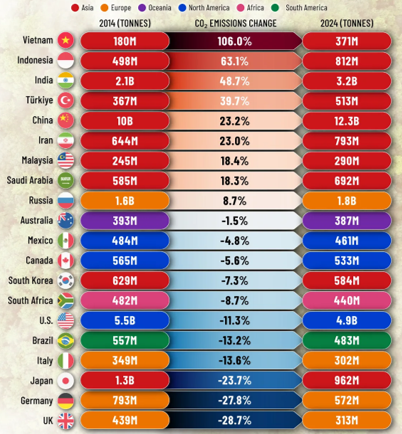
Figure 1 – Net emissions change from world’s 20 largest emitters (counting industry and fossil fuel combustion only, excluding land use changes) in 2024 compared to 2014. Most extreme growth has taken place in lower- to middle-income nations expanding industrial production and experiencing rapid population growth. Emission reductions have occurred primarily in richer nations rapidly losing industrial capacity and experiencing little population growth. Source: Ranked: Where Emissions Are Rising Fastest
Is ‘net zero’ GHG emissions a realistic global target?
The International Energy Agency published Net Zero by 2050 – A Roadmap for the Global Energy Sector in 2021. They laid out a series of milestones demonstrating a scenario whereby global emissions could be reduced to net zero (Figure 2). Emissions would be reduced across all sectors, and net emissions would be reduced further using carbon capture and storage. Yet instead of falling to 30 gigatonnes (Gt) in 2025, energy-related emissions increased to 37.8 Gt Global Energy Review 2025: CO2 Emissions. A brief inspection of individual milestones – perhaps better termed aspirations – shows that all 2021-25 targets have failed, and that no realistic pathways exist toward achieving future milestones.
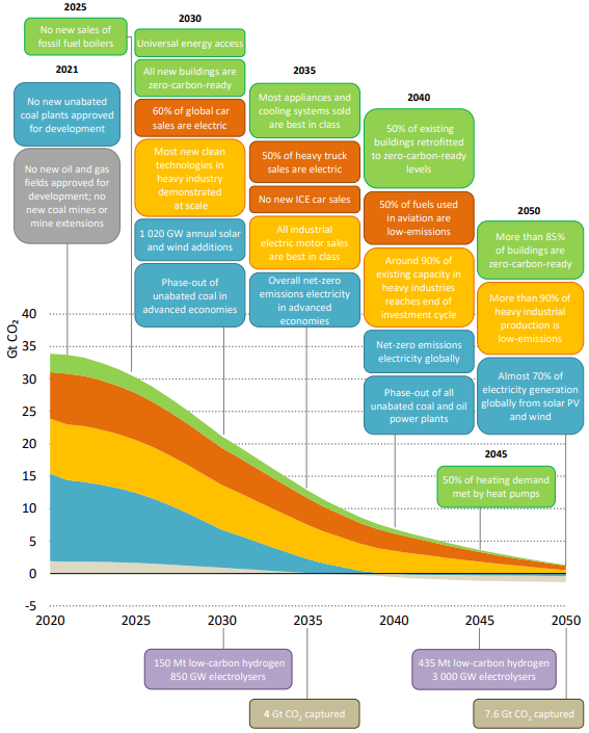
Figure 2 – IEA Net Zero by 2050 key milestones in the pathway to net zero by 2050 from 34 gigatonnes in 2020. The IEA reported energy-related emissions of 37.8 Gt in 2025. Net Zero by 2050 – A Roadmap for the Global Energy Sector
Despite these failures, many net-zero advocates promote the idea that emission regulations will become increasingly stringent across the globe, and that industries and jurisdictions that do not plan for stricter emission regimes will be “left behind” if they build new fossil-fuel-fired electricity generation, transportation, or other infrastructure – future “stranded assets”, in crisis-speak.
But is this true? Will regulations become more and more strict, making today’s hydrocarbon-powered technology obsolete? It is a hugely important question, because nothing gets built overnight; decisions must be made today on building things that will start operating years from now.
In fact, recent developments in the energy world show exactly the opposite as people realize that energy security – available, affordable, and abundant energy for all – trumps emission reductions every time (also known as Pielke’s iron law of climate policy Understanding the ‘Iron Law’ of Climate Policy). Voters in rich countries are beginning to realize that it is expensive to replace things that already work well solely in the pursuit of lower emissions, not better performance – such as:
- Reconfiguring transportation to run on batteries instead of liquid fuels, including building entirely new fueling infrastructures.
- Building incredibly complex electrical generation systems relying on intermittent renewables, including huge expenditures on energy storage (batteries and pumped hydro), massive investment in expanded grids to carry electricity from where it must be generated to where it is consumed, and maintenance of reliable backup generation capacity such as gas-fired power plants to ensure power can be delivered at all times.Proponents of solar power often talk about the falling price of solar panels – but they are only a small component of system costs. It is like saying cars are going to be a whole lot cheaper because the price of snow tires has come down. What matters is the cost of the system to deliver electricity – not the cost of one component.
- Building hugely expanded supply chains to extract, process and transport the critical materials needed to support low-emission technologies – such as lithium, copper, nickel, graphite, and rare earth elements.
As a result, many emission-related mandates, predictions, expectations and commitments – call them what you will – have been rolled back. A few examples:
- Electric vehicles
- Canada had mandated 100% EV sales by 2035, but now expects industry to meet reduced emissions standards without banning ICE (internal combustion engine) vehicles. Goodbye EV sales mandate, hello purchase rebates. Carney shakes up Canada’s auto industry
- The United Kingdom is introducing “flexibility” to their EV mandates – a convenient first step toward real mandate changes. Flexibility or uncertainty? Risks of the proposed changes to the UK Zero Emission Vehicle Mandate
- The United States has eliminated direct EV purchase subsidies. Ashes to ashes: The electric vehicle mandate is well and truly dead
- Mandated shutdowns of coal- and gas-fired power plants have been delayed in many jurisdictions as grid operators realize they cannot meet generation obligations without them. Retirement delays of U.S. electric generating capacity may continue in 2026
- Construction of new wind and solar generation is being pushed back in many jurisdictions. Industry watchers raise alarm on Alberta renewable-energy project cancellations, Why Trump’s $2 billion buyoff to cancel offshore wind farms is a bad deal for American taxpayers and the US energy supply
- Deindustrialization has been destroying jobs and prosperity driven in large part by low-emission policies in places such as Germany, California, the United Kingdom, and Canada. Germany Has an Escalating Deindustrialisation Problem. Canada, for one, is pulling back from the extreme deindustrialization policies of the Justin Trudeau era, backing major resource projects to put energy production, prosperity, and jobs ahead of emission targets. With a possible referendum looming, Carney and Smith find common ground on carbon pricing
Different people spin these stories different ways, but the bottom line is that all levels of government – and the majority of citizens – are stepping back from carbon constraints, and will step back further as energy security dictates.
That said, progress is slow and uneven, and ideology still trumps sound analysis in many places. Many policy-makers and regulators, particularly in Europe, continue to voice net-zero objectives as justification for building ever more cumbersome reporting systems and regulations. The Canadian province of British Columbia’s electrical system operator BC Hydro, which has been a net importer of electricity for the past few years, is planning to shut down a natural gas generator on Vancouver Island, apparently without the faintest idea of how to replace the desperately needed firm capacity. NDP once championed natural gas power plant; now it’s a pariah
Will we live in a carbon-constrained world?
Ultimately, we will move toward a happy medium, creating sounder policies to support energy security while minimizing environmental impacts (all environmental impacts, not just carbon-dioxide emissions). Constraining carbon-dioxide production will be an important piece of the puzzle, but it will never be the master switch.
The process will be long and painful. There are too many competing and polarized viewpoints to be readily reconciled, particularly as many are driven by emotion and distrust rather than reason and sound analysis. Various factions will have to be dragged kicking and screaming toward resolution, with plenty of collateral damage incurred along the way.
So, build those gas-fired electrical generators – we are going to need them for a long, long time.
(Brad Hayes – BIG Media Ltd., 2026)